Saad Ullah
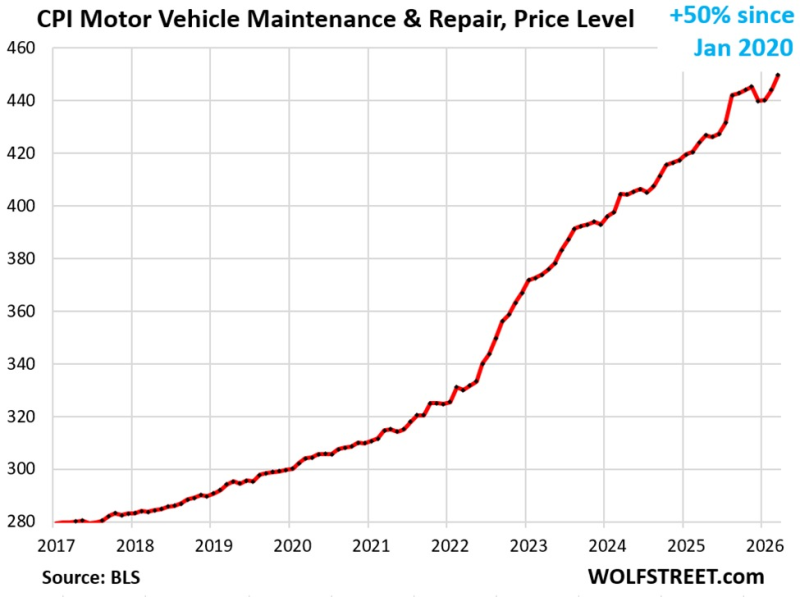
Owning a car in America is becoming structurally more expensive, with maintenance and repair costs now up roughly 50% since early 2020. As The Kobeissi Letter noted, this surge - alongside rising insurance and parts costs - is increasingly shaping the broader cost of living for US households.
A Relentless US Auto CPI Climb With No Real Reversal
The chart shows a clear and uninterrupted uptrend in the CPI index for motor vehicle maintenance and repair. From around 280 in 2017, the index trends steadily higher into 2020 before accelerating sharply through 2022.
The structure is defined by persistent higher highs and higher lows with no meaningful pullbacks - even slower growth phases resolve into continuation rather than reversal, which is the signature of structural rather than cyclical inflation.
What stands out is the consistency of the move. The structure is defined by persistent higher highs and higher lows, with no meaningful pullbacks or breakdowns. Even periods of slower growth resolve into continuation rather than reversal, keeping the trajectory intact. By 2025-2026, the index approaches the 450 level - marking the roughly 50% increase from January 2020 highlighted in the source.
The Acceleration Phase That Reset the Auto Cost Trend
The most aggressive expansion occurs between 2021 and 2023, where the slope steepens significantly. During this stretch, the index pushes decisively above the 320-330 area and continues climbing without interruption.
Following that surge, the trend does not weaken - it simply transitions into a steadier advance. The absence of sharp corrections suggests sustained pricing pressure within this category rather than temporary spikes. The full scope of the vehicle cost surge across related categories reinforces the picture:
- Maintenance and repair costs up ~50% since 2020
- Auto insurance up ~56%
- Parts and equipment up ~27%
The trend did not reverse after the 2021-2023 acceleration - it transitioned into a steadier advance, which means the cost base reset rather than the costs themselves being temporary.
Food Prices Jump 2.7% as Dining Out Costs Surge 4.1% in December shows how vehicle costs are not an isolated category but part of a broader pattern where essential household spending categories have been repricing upward simultaneously - compounding the overall cost of living pressure on American households.
A Cost Component That Keeps Building US CPI Pressure
Vehicle-related expenses account for a meaningful share of the CPI basket, amplifying their impact on overall inflation. The chart reinforces this by showing a long-duration trend that remains firmly upward with each new high confirming that cost pressures in this category are not easing.
Markets Go Wild: Fed Rate Cut Bets Explode After Confusing Inflation Numbers adds the policy dimension - showing how persistent inflation in categories like auto maintenance complicates the Fed's ability to confidently declare victory over price pressure, even when headline numbers occasionally soften.
With each new high, the index confirms that cost pressures in this category are not easing - they continue to build incrementally, contributing to the broader inflation environment that is keeping household budgets under sustained pressure.
Italy CPI Inflation Holds Steady at 1.6% in September provides a useful international contrast - where European vehicle and maintenance cost inflation has behaved very differently, highlighting that the US auto cost surge is not a universal post-pandemic phenomenon but reflects structural factors specific to the American market including labor shortages, parts supply constraints, and insurance market dynamics.
 Saad Ullah