Marina Lyubimova

There's a pattern in the latest UK council tax data that goes beyond politics. Whether you're looking at Labour-run councils, Conservative ones, or anything in between, the numbers all tell the same story: costs are going up, and nothing is pushing them back down.
Tom Harwood flagged the breakdown this week, and the chart that accompanies it is striking in its simplicity. No reversals, no outliers, no party bucking the trend.
UK Council Tax Rates Climb from 3.3% to 4.2% With No Signs of a Ceiling
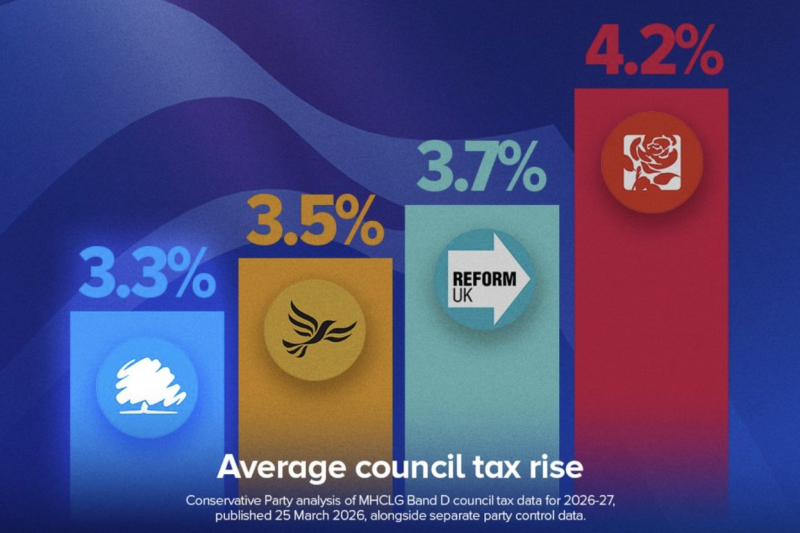
The progression across political groups runs like a staircase:
- 3.3%
- 3.5%
- 3.7%
- 4.2%
Each step builds on the last without any rejection or hesitation at higher levels. In structural terms, this looks less like a policy choice and more like a system operating under shared constraints that nobody has found a way around.
Local councils are constrained by mandated spending, particularly in areas such as social care and SEND provision.
Earlier levels like 3.3% and 3.5% no longer act as ceilings. They've become the floor. The 4.2% reading at the top of the range shows no sign of being capped, which suggests the pressure driving these increases hasn't peaked.
This feeds directly into the broader UK inflation picture. UK CPI recently came in at 3.0%, the lowest since March 2025, but council tax hikes of this scale add persistent cost pressure that doesn't respond to monetary policy in the usual way.
Cross-Party UK Council Tax Increases Point to a Systemic Issue, Not a Political One
What makes this dataset unusual is how tightly grouped the numbers are. Different political groups are all landing within a narrow upward range. That kind of consistency almost never happens when increases are driven by individual political decisions. It happens when everyone is responding to the same underlying pressure.
The consistency across categories reinforces the idea that the trend is systemic, not a product of isolated policy decisions.
Social care and SEND spending are the two areas Harwood specifically highlights as the mandated drivers. These are costs councils can't easily cut, which means the adjustment falls on the revenue side instead. Year after year, that means higher bills for residents.
UK 10-year gilt yields have already topped 5% for the first time since 2008, partly on inflation concerns. Council tax trajectories like this one don't help that narrative.
UK Cost Pressure Pattern Shows No Correction as Inflation Forecasts Rise
The structure here carries one clear message: this isn't a temporary spike. A steady upward progression with no visible corrections and higher levels reached across all groups is the kind of pattern that reflects ongoing systemic pressure rather than a one-off adjustment.
US and global inflation forecasts are also tracking upward at 2.7% for 2026, which puts the UK's domestic cost pressures in a wider context. Local government finances are just one piece of a larger picture, but they're one of the most direct and unavoidable ones for ordinary households.
The ceiling on UK council tax isn't holding. And until the structural drivers change, the staircase keeps climbing.
 Marina Lyubimova