Marina Lyubimova
India's consumer price inflation climbed to 3.21% in February 2026, up from 2.74% in January, as the country's M3 money supply continued to expand faster than levels consistent with price stability. The latest data points to a familiar pattern: when liquidity grows beyond target thresholds, inflation tends to follow. For India, that dynamic is back in focus.
M3 at 11.19%: Why the Golden Growth Rate Matters
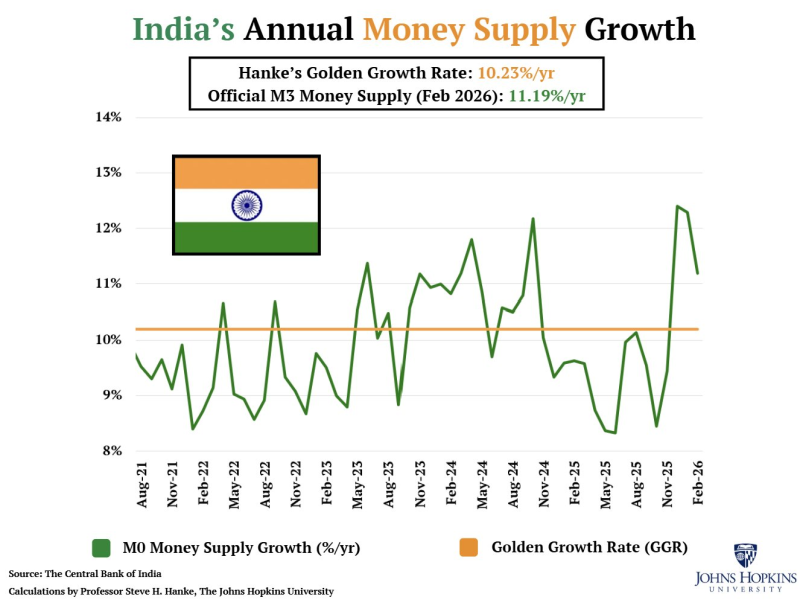
India's M3 money supply is currently growing at 11.19% year over year, exceeding what economist Steve Hanke refers to as the "Golden Growth Rate" of roughly 10.23% per year. This benchmark is widely used to estimate the money supply growth rate compatible with India's official 4% inflation target. When actual growth runs above this level, excess liquidity tends to feed into rising prices - and the February CPI reading suggests exactly that is happening.
A Pattern That Repeats Since 2021
Historical data shows India's M3 growth has swung between roughly 8% and above 12% since 2021, with multiple periods breaching the optimal threshold. Each time growth surpassed the golden rate line, price pressures tended to build. The February 2026 reading follows that same script, with monetary expansion currently running hotter than levels needed for stable prices. Similar dynamics have played out in other economies - Hungary's inflation puzzle offers a parallel case study in how money supply growth shapes price outcomes.
The takeaway is straightforward: sustained M3 expansion above target is not a neutral event. It gradually translates into higher consumer prices, and India's latest inflation uptick reinforces that principle. Aligning money supply growth more closely with the golden rate will likely be key to keeping inflation near the 4% target over the coming quarters.
 Marina Lyubimova