Alex Dudov

In 2026 global liquidity is increasing at a faster pace - money supply is growing at rates that contradict statements about monetary tightening, according to Jeroen Blokland.
Since the start of this year, global money supply has been expanding at an annualized pace of 16%.
As this expansion grows in size, it demonstrates a mechanic that people often ignore when they discuss inflation. That is the true hurdle rate of inflation if your fiat money is sitting in the bank. It shows that purchasing power decreases because the money supply expands, rather than only because consumer prices change.
By looking at the history of the term, Blokland shows that the first definition of inflation related directly to the creation of money. Inflation originally meant exactly that: the inflation of the money supply through creation or debasement. On this point, he compares the situation to historical periods like when the Romans reduced the amount of precious metal in their coins.
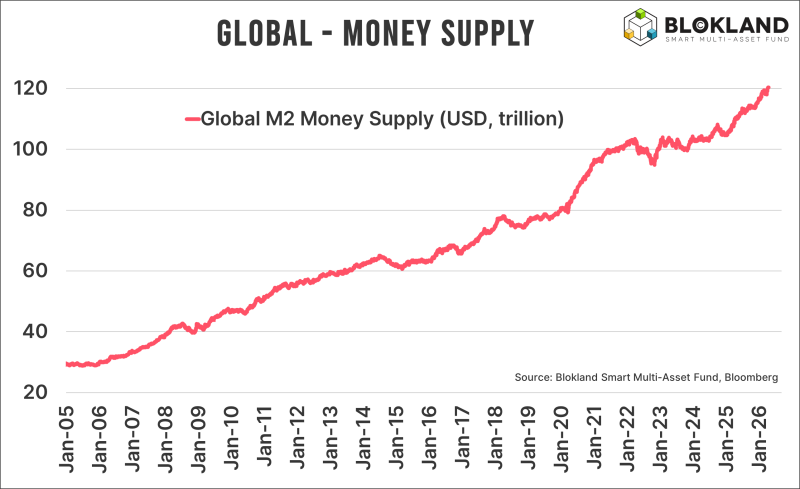
The Expansion of Liquidity Is Permanent
With many news reports focusing on geopolitics and investments in AI, liquidity is still the factor that moves markets. Due to the fact that global debt continues to accumulate, institutions must create more money to allow for refinancing and to keep the financial system stable.
One of the key results of debt accumulation, the continuous money creation to keep liquidity high and the global refinancing machines going, objectively reveals that the mechanics have not changed.
If this is the case then conversations about returning to standard policies are not accurate. You can talk about the normalization of interest rates and monetary policy all you want, but the reality is simple: it is not happening.
Fiscal Dominance Is Still Present
And even when the economy grows and companies earn more profit, the general monetary system does not change. There are permanent forces that make liquidity expansion more likely than tightening.
To understand the data, one must see a specific fact - markets might focus on interest rates and inflation data but the global money supply is growing steadily - this process is what determines the prices of assets, reduces the value of paper currency and supports the global financial system.
 Alex Dudov