Alex Dudov
⬤ China's monetary picture is getting harder to ignore. As economist Steve Hanke has noted, China's inflation is running at 1.3% annually, still short of the official 2% target. M2 money supply growth reached 9% year over year as of February 2026, remaining below the so-called "Golden Growth Rate" of 10% - the threshold associated with stable inflation outcomes.
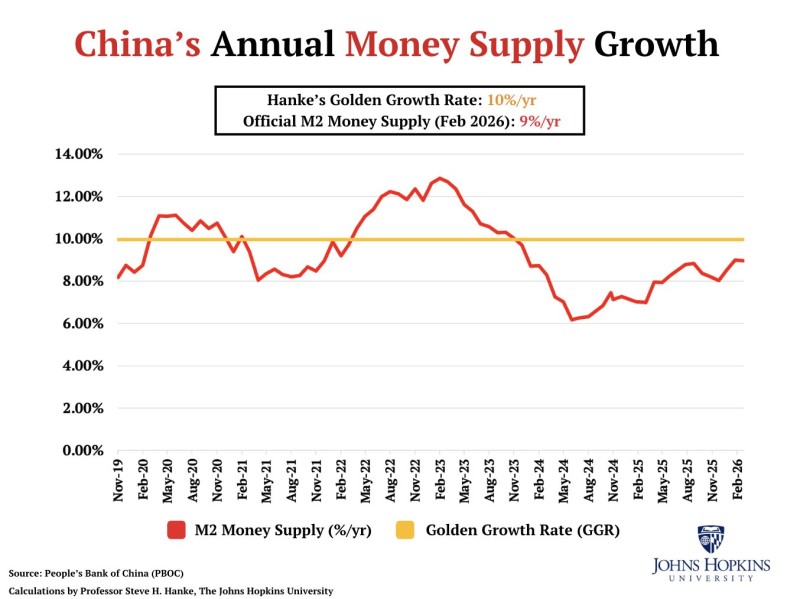
⬤ The trend in M2 has been volatile. Growth peaked above 12% during 2022 to 2023 before falling sharply toward the 6% range in 2024. Since then it has partially recovered, but has not yet cleared the 10% benchmark. That persistent gap points to liquidity expansion that is still too modest to push prices meaningfully higher, a theme echoed in reporting on China's slowing money supply growth and deflation concerns.
Current monetary conditions are not yet aligned with China's inflation target.
⬤ The connection between M2 and consumer prices sits at the core of this story. At 9%, money supply growth remains below the level historically needed to sustain 2% inflation. That gap is not new - it has been a consistent feature of the current cycle, and its effects show up clearly in price data. A previous reading of just 0.2% inflation with M2 still below target illustrated just how directly insufficient liquidity feeds into weak pricing dynamics.
⬤ Unless liquidity conditions strengthen further, inflation in China is likely to remain below target. The 9% M2 reading represents progress from 2024 lows, but the distance to the 10% Golden Growth Rate still matters. Until that gap closes, monetary conditions will continue to work against the kind of price stability Beijing is aiming for.
 Alex Dudov