Usman Salis

A historic wave of capital flight is sweeping through Asian emerging markets. According to Crypto India, Bloomberg data confirms that foreign investors withdrew approximately $52 billion in equities during March alone - the largest monthly outflow on record. The move signals something more serious than routine volatility: a decisive repositioning by global investors away from the region.
What makes this episode distinct is the context in which it is happening. Even during the 2020 pandemic shock and the geopolitical disruption that followed Russia's invasion of Ukraine, outflows from Asian emerging markets stayed significantly smaller. Those events rattled markets and triggered selling, but nothing on this scale.
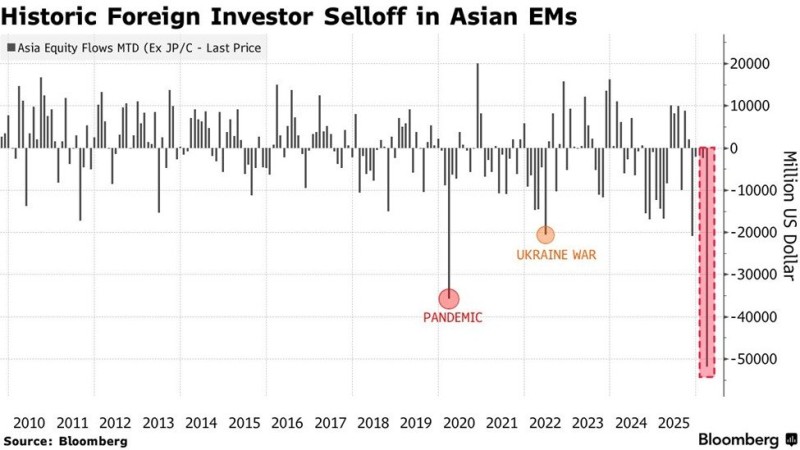
The extreme reading underscores a decisive shift in capital flow dynamics - rather than short-term volatility, the data suggests a meaningful repositioning by global investors away from Asian emerging markets.
$52B Outflow Breaks Every Prior Extreme in the Data
Historically, foreign flows into Asian emerging markets have fluctuated within a defined band, with occasional sharp dips. Prior outflows typically ranged between roughly -$10 billion and -$30 billion. The latest figure extends past -$50 billion, establishing a new extreme that rewrites the historical chart entirely.
This is not a deepening of a familiar trend - it is a breakout beyond all previously observed limits. The chart data shows a collapse in equity flows with March's reading plunging past every prior extreme, including those seen during past crises. That kind of magnitude points to synchronized withdrawal rather than isolated market weakness.
The magnitude of the selloff reflects a synchronized withdrawal rather than isolated market weakness - broad-based liquidation across multiple markets rather than rotation within the region.
India, South Korea and Taiwan Hit Hardest by $52B in Foreign Selling
The largest selling has been concentrated in three markets: India, South Korea, and Taiwan. These are among the most liquid equity markets in the region and typically carry the highest levels of foreign investor participation - which also makes them the first places institutional capital exits when sentiment shifts.
The scale of the outflow suggests broad-based liquidation across multiple markets rather than rotation within the region. Investors are not moving money from one Asian market to another - they are pulling it out of the region altogether.
What the Record Outflow Signal Means for Global Capital Flows
The $52 billion reading sits within a broader tension that has shaped global capital allocation decisions for some time. Longer-term sentiment toward emerging markets has remained complex - there have been periods when investors viewed them as undervalued relative to developed markets. That valuation case has not gone away.
This aligns with broader observations about global capital behavior, where shifts in sentiment can quickly trigger large reallocations across regions - making such reversals more impactful than they were in prior decades.
But valuation appeal and capital flows can diverge sharply during periods of risk-off sentiment, and that is precisely the dynamic playing out now. Whether these outflows stabilize or continue to accelerate will be one of the most closely watched signals for global equity markets in the months ahead.
 Usman Salis