Marina Lyubimova

Quantum computing has spent years promising a technological revolution. Investors are now being asked to decide how much that future is worth today.
Quantinuum, one of the world's largest standalone quantum-computing companies, is seeking a valuation of up to $12.7 billion in its planned U.S. initial public offering. The company intends to raise as much as $1.05 billion by selling roughly 21 million shares priced between $45 and $50 each, according to its filing.
The proposed valuation would place Quantinuum among the most valuable publicly traded companies focused primarily on quantum computing, despite the industry's still-limited commercial revenues and unresolved technical challenges.
The IPO arrives at a moment when investor interest in strategic technologies is accelerating. Artificial intelligence infrastructure, defense technology and advanced computing have all attracted substantial capital despite ongoing geopolitical uncertainty. Quantum computing appears to be joining that group.
Quantum Stocks Are Already Trading on Future Expectations
Quantinuum's market debut is taking shape against a backdrop of strong gains across publicly traded quantum-computing stocks.
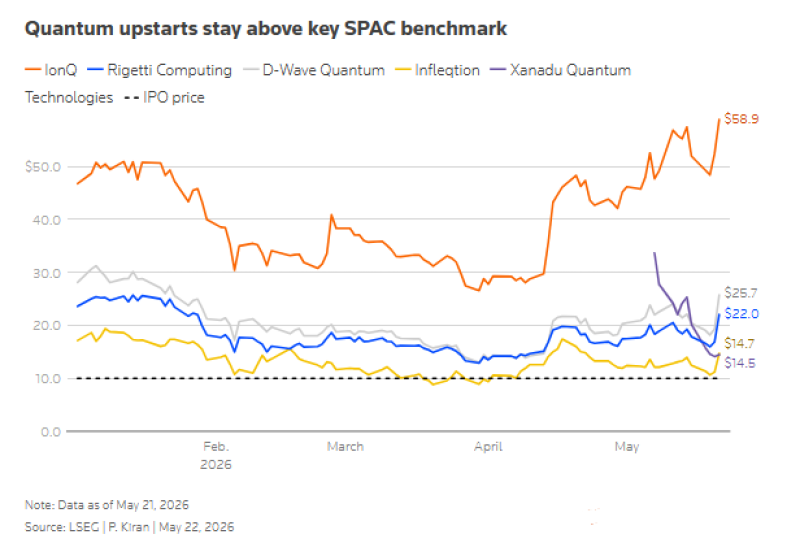
Shares of publicly traded quantum-computing firms have rallied sharply in recent months. IonQ has climbed to nearly $59 per share, while D-Wave Quantum and Rigetti Computing continue to trade more than double the $10 level that served as a benchmark for many earlier SPAC listings.
The move suggests investors are increasingly willing to price in future commercial adoption rather than current profitability. That same optimism may provide a favorable backdrop for Quantinuum's public debut.
Government Money Is Flowing Into Quantum Computing
Investor enthusiasm has also been reinforced by growing government involvement. Just days before Quantinuum disclosed its IPO plans, the Trump administration announced a $2 billion initiative aimed at strengthening U.S. leadership in quantum technologies through equity investments across nine companies. Quantinuum is expected to receive approximately $100 million under the program.
The announcement reflects a broader shift in how policymakers view quantum computing. Once considered a niche research field, the technology is increasingly being treated as strategic infrastructure with potential applications in cybersecurity, defense, materials science and pharmaceutical development.
Revenue Is Growing, but Losses Are Growing Too
Like many frontier-technology companies, Quantinuum remains deeply unprofitable.
Quantinuum Financial Snapshot
| Fiscal Year | Revenue | Net Loss |
| 2024 | $23.0 million | $144.1 million |
| 2025 | $30.9 million | $192.6 million |
Revenue increased by roughly 34% year-over-year, reflecting growing commercial adoption of the company's products and services. However, losses expanded at a similar pace as Quantinuum continued investing heavily in hardware development, research programs and commercialization efforts.
The figures illustrate the central challenge facing the quantum industry. Companies must spend aggressively today in pursuit of breakthroughs that could take years to generate meaningful cash flow. Yet investors appear willing to finance that journey.
Last September, Quantinuum raised approximately $600 million at a $10 billion pre-money valuation. The round attracted a mix of technology, financial and industrial investors, including NVIDIA's venture arm, JPMorgan Chase, Amgen, Mitsui and several global investment groups.
That shareholder roster suggests institutional investors increasingly view quantum computing as a potentially transformative platform rather than a speculative science project.
More Than Another Tech IPO
Founded through the combination of Honeywell's quantum-computing business and Cambridge Quantum, Quantinuum has positioned itself as a full-stack provider spanning hardware, software and quantum cybersecurity solutions. That broader business model may help differentiate the company from several publicly traded peers that remain focused primarily on hardware development.
The upcoming IPO will therefore be watched for reasons extending beyond one company's valuation. Investors will be assessing whether public markets are prepared to finance the next phase of quantum computing's development - much as they embraced AI infrastructure before it became one of the market's dominant investment themes.
Quantinuum is asking investors to support a company generating less than $31 million in annual revenue at a valuation approaching $13 billion. Whether the market embraces that proposition may reveal as much about confidence in quantum computing's future as it does about the company itself.
 Marina Lyubimova