Eseandre Mordi

For Seattle's technology sector, the number is significant. For Meta, it is part of a much larger reallocation of resources that is reshaping the economics of the AI era. The company remains highly profitable and continues to generate billions in cash flow. Yet while headcount is being reduced in parts of the business, spending elsewhere is accelerating at a pace rarely seen among large public companies.
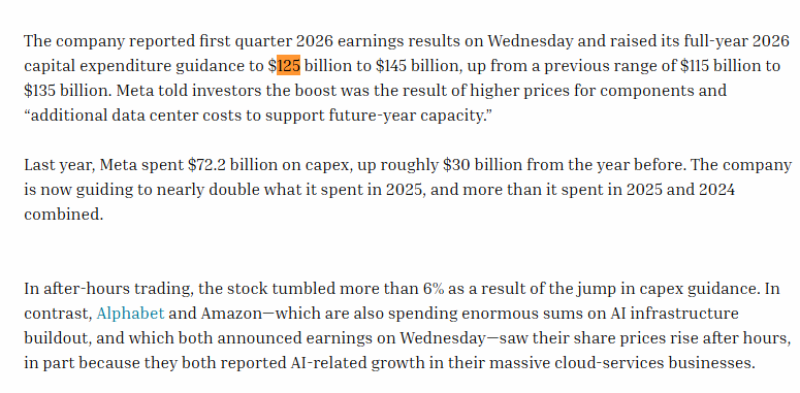
Meta recently raised its 2026 capital expenditure forecast to $125 billion-$145 billion, up from a previous range of $115 billion-$135 billion. The figure is nearly double the $72.2 billion the company spent in 2025 and reflects the growing cost of building AI infrastructure at scale.
Management attributed the increase to higher component prices and additional data-center investments required to support future AI capacity. The spending covers the physical backbone of Meta's AI strategy: servers, networking equipment, advanced chips and massive computing facilities designed to train and run increasingly sophisticated models.
The contrast is difficult to ignore. As billions flow into infrastructure, thousands of jobs are being eliminated across different parts of the organization. That pattern is not unique to Meta.
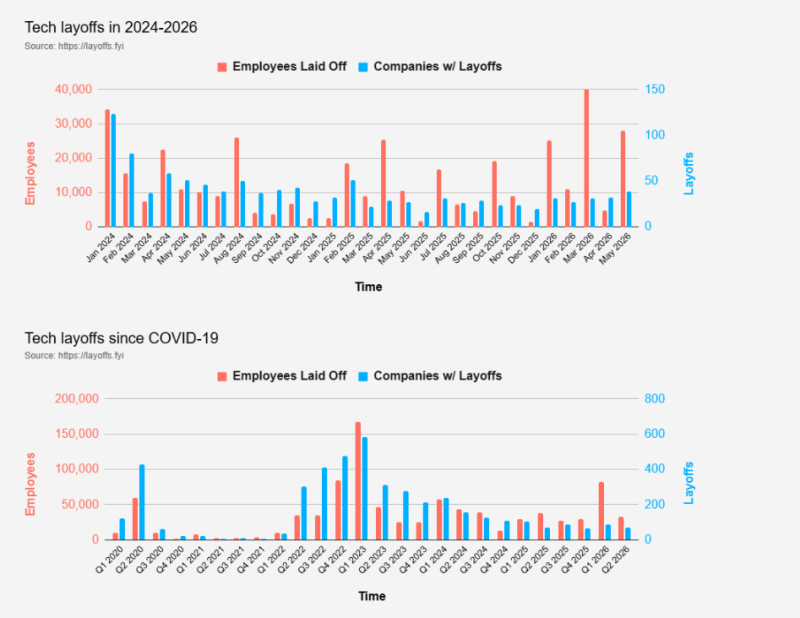
Tech Layoffs Remain Elevated Across the Industry in 2026 Source: Layoffs.fyi
Layoffs.fyi data show that technology companies continue to cut jobs at a substantial pace in 2026. Monthly layoffs remain well above pre-pandemic norms, even as the industry's largest players increase spending on AI platforms, cloud capacity and next-generation computing infrastructure.
The disconnect reflects a broader shift in priorities across Silicon Valley. During the pandemic-era expansion, technology companies competed aggressively for talent and rapidly expanded their workforces. The AI cycle is producing a different investment profile. Capital is increasingly being directed toward compute capacity rather than headcount growth.
King County offers a particularly visible example of that transition. The Seattle region has become one of the most important engineering hubs for cloud computing, artificial intelligence and data-center development. Large-scale reductions by Meta therefore resonate beyond a single company, influencing hiring conditions across the broader technology ecosystem.
The 1,395 layoffs disclosed in Washington are unlikely to change Meta's long-term strategy. Instead, they offer a glimpse of how that strategy is being financed. The company's future growth bets increasingly revolve around data centers, chips and computing power and the balance between capital investment and workforce expansion is shifting accordingly.
In that sense, the King County WARN notice is more than a local employment story. It is another sign that in the race to build AI infrastructure, compute is becoming a larger line item than people.
 Eseandre Mordi