Peter Smith

⬤ The Japanese yen took a hit Tuesday, dropping nearly 1% against the dollar after local media reported that Prime Minister Sanae Takaichi pushed back against further Bank of Japan rate hikes during a private meeting with Governor Kazuo Ueda. The report rattled markets and sent USD/JPY climbing back above 155, marking the yen's worst session in two weeks.
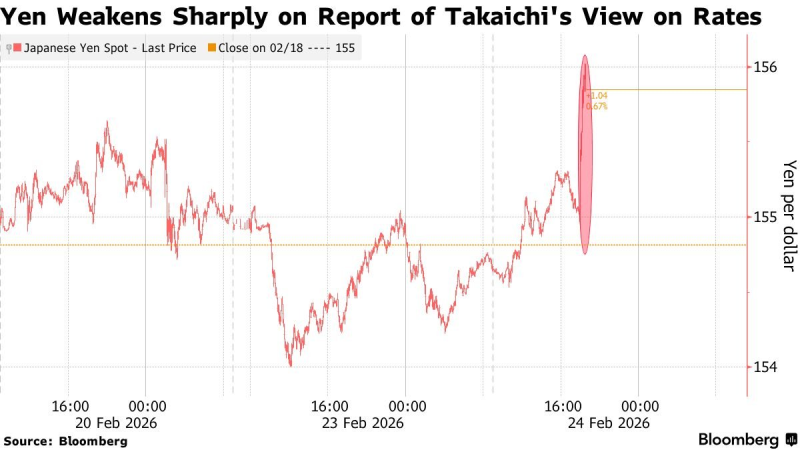
⬤ According to The Mainichi, Takaichi's tone was noticeably tougher than in previous discussions — a signal that political pressure on the BOJ may be building. The yen slid roughly 0.7% to around JPY 155.7 per dollar following the report, as traders quickly unwound bets on near-term tightening. This is not the first time political commentary has rattled yen bulls; the yen has already touched 8-month lows against the dollar in recent months, a pattern that keeps resurfacing whenever BOJ credibility comes into question.
The uncertainty over timing and political influence on policy underscores the delicate balance Japan's central bank faces in normalizing monetary settings while grappling with currency weakness.
⬤ Adding to the pressure, Japan's core inflation has been slowing — complicating the BOJ's case for raising rates further. Markets are now pricing in only a modest chance of a hike by the April meeting. The BOJ had already pushed rates to 0.75%, the highest in 30 years, making any further move politically sensitive and data-dependent.
⬤ A weaker yen also feeds through to import costs and domestic inflation expectations, which could complicate both monetary and fiscal debates in Tokyo. For now, traders will be watching every word from BOJ officials and government ministers closely — because in Japan's currency market, rhetoric moves just as fast as rate decisions.
 Peter Smith