Alex Dudov

U.S. crude oil exports are running at or near record highs, with April flows reaching 4.7 million barrels per day and reinforcing the country's growing role in balancing disrupted global oil trade. John Kemp flagged that this is not a one-off jump - crude exports have climbed from just 0.5 million b/d in April 2015 to 4.7 million b/d so far in April 2026, while total U.S. petroleum exports have risen to roughly 12.2 million b/d. The latest increase comes as the closure of the Strait of Hormuz triggers a worldwide scramble for replacement crude supplies.
Crude exports have climbed from just 0.5 million b/d in April 2015 to 4.7 million b/d in April 2026 - a near-tenfold expansion that has transformed the United States from a marginal player into one of the most important swing suppliers in the seaborne market.
A Decade of U.S. Crude Export Growth Reaches a New Peak
The long-term data tells a compelling story about structural change in global oil flows. Refined products remain the larger component of total U.S. petroleum exports, rising from 3.7 million b/d in April 2015 to 7.5 million b/d in April 2026. But the sharpest change has come from crude - that segment has expanded almost tenfold over the same period, turning the United States into a primary source of swing supply for the seaborne market.
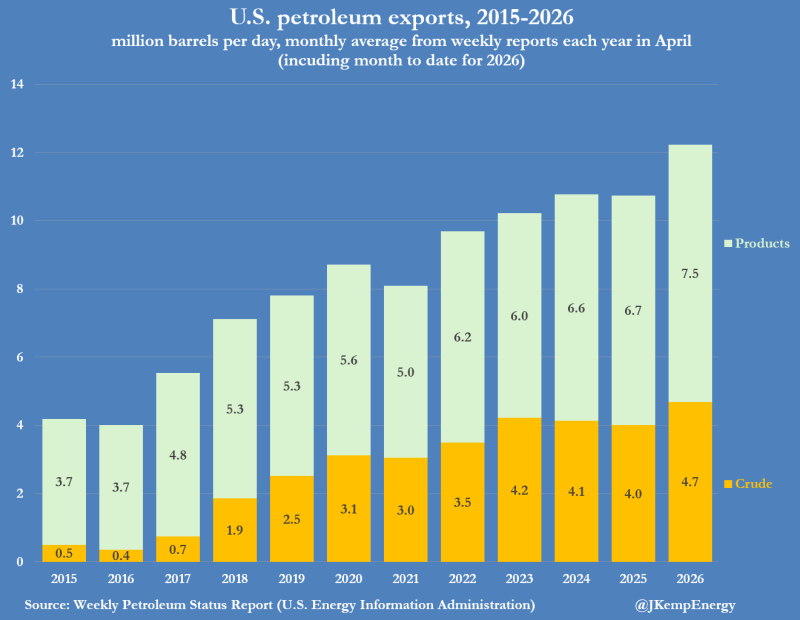
What stands out in the latest reading is not only the absolute level, but the pace of change. April crude exports are running 0.7 million b/d above the same month last year - a sizable year-over-year increase for a market this large. That pushes crude flows to the highest level in the series, while total petroleum exports also set a fresh high near 12.2 million b/d.
When major trade routes are disrupted, U.S. barrels can move quickly enough to matter. April's 4.7 million b/d crude export pace suggests buyers are actively pulling more U.S. supply into the global system.
The Hormuz Disruption Driving the Rush for U.S. Crude
The export surge is directly tied to disruption around the Strait of Hormuz. WTI topped $96 and Brent neared $111 as Hormuz tanker traffic collapsed toward zero, quickly tightening global supply and raising the premium on available barrels. That disruption has forced producers and buyers to reroute flows aggressively.
Related reporting showed Saudi Arabia lifting exports through Yanbu to roughly 4.19 million b/d as the market searched for alternatives to Gulf transit. Against that backdrop, rising U.S. crude exports fit into a broader reordering of global oil logistics rather than a purely domestic supply story.
The rerouting theme continued to build from there. Saudi Arabia's Yanbu exports approached 5 million barrels per day as replacement supply channels scaled rapidly under pressure - a clear sign that the market is adapting to a new logistics reality, not simply waiting for disruptions to resolve.
Why U.S. Crude Exports Now Do the Marginal Balancing Work
The bigger point is structural. U.S. export growth has become a permanent feature of the oil market, not a cyclical anomaly. Refined products still account for the larger share of total petroleum exports, but crude is increasingly doing the marginal balancing work. The numbers break down as follows:
- Total U.S. petroleum exports: roughly 12.2 million b/d in April 2026
- Refined products: 7.5 million b/d (up from 3.7 million b/d in April 2015)
- Crude oil: 4.7 million b/d (up from 0.5 million b/d in April 2015)
- Year-over-year crude export growth: 0.7 million b/d
 Alex Dudov