Saad Ullah

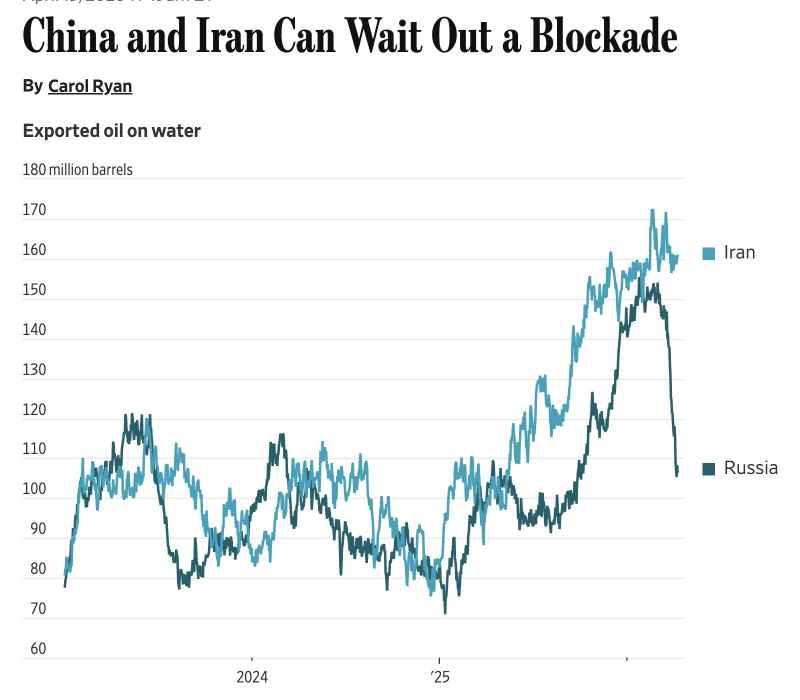
Iran appears to be building time into its export strategy. As Steve Hanke argued, more than 160 million barrels of Iranian oil are now sitting on tankers outside the Strait of Hormuz - a volume that could allow sales to continue at elevated prices well into the coming months if pressure on shipping routes intensifies.
The Iran Oil Inventory Trend That Changes the Blockade Setup
The chart's central message is straightforward: Iran's exported oil on water has been rising sharply and is now near the top of the displayed range. The line climbs from roughly 80 million barrels in 2023 to above 160 million barrels in 2026, with a sequence of higher highs that points to persistent accumulation rather than a temporary spike.
That matters because floating storage changes the market's sensitivity to immediate disruption. If a large amount of crude is already loaded and offshore, the pressure from a blockade does not hit all at once. The barrels are not theoretical supply - they are already on water and already committed to buyers.
WTI Oil Surges Above $101 as Iran Deadline Drives $100 Break captured how quickly oil prices respond to Iran-related pressure scenarios - reinforcing why the floating storage buffer matters as a mechanism that could slow rather than prevent the price impact of any supply disruption.
Russia Pulls Back While Iran Holds Near Oil Storage Highs
The second line on the chart adds an important contrast. Russia's exported oil on water also rose strongly - but the most recent move is sharply lower, dropping back toward nearly 100 million barrels. Iran, by comparison, remains elevated near the 160 million mark.
This divergence reshapes the visual balance of the chart. The latest structure shows Iran holding near peak inventory levels while Russia loses momentum - leaving Iran with the stronger floating-storage cushion of the two sanctioned producers currently navigating geopolitical pressure around their export routes.
Why the July Iran Oil Argument Matters
The source makes a specific timing claim: if Iran can keep selling from offshore stock until July, the effectiveness of a blockade weakens materially. The chart supports that broader point by showing the inventory buffer is unusually large right now.
WTI Oil Price Analysis: Crude Crashes 14% in Minutes on Iran News shows how sensitive oil prices are to Iran-related headlines in either direction - reinforcing that the market is pricing scenarios, and the floating storage buffer changes which scenarios are most plausible on what timeline.
China Pivots Oil Strategy: 300,000 Barrel Daily Shortfall Drives Shift to Canadian Crude adds the demand-side dimension to the floating storage picture, showing how China - the primary buyer of Iranian offshore crude - has been actively managing supply chain alternatives in a way that gives Iran's stored barrels multiple distribution channels even under pressure.
The takeaway is less about whether geopolitical pressure disappears and more about whether it arrives fast enough to matter before stored supply is worked down. For now, Iran has built a sizable delay mechanism into the system - and that changes the calculus around how quickly any disruption translates into actual market impact.
 Saad Ullah