Usman Salis

For much of the generative AI era, OpenAI was the clear leader in corporate AI adoption. That changed in April 2026.
According to the latest Ramp AI Index, 34.4% of U.S. businesses paying for AI tools and models now subscribe to Anthropic products, compared with 32.3% for OpenAI. It marks the first time Anthropic has moved ahead of its larger rival since Ramp began tracking AI-related corporate spending.
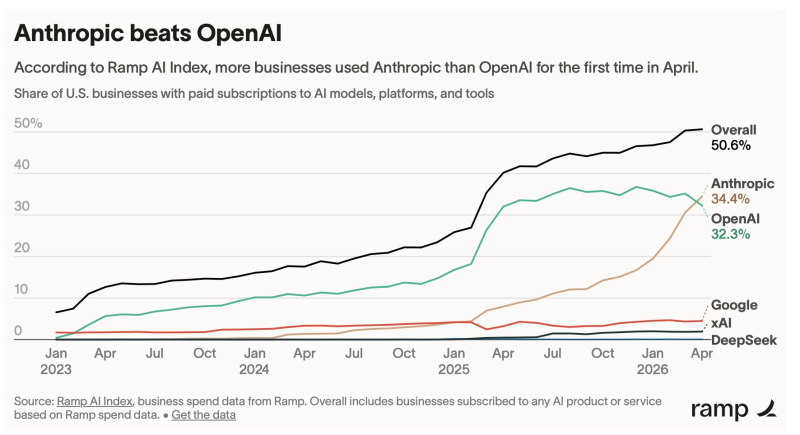
The milestone reflects a broader transformation in the enterprise AI market. More than 50.6% of U.S. businesses now pay for at least one AI product or service, up from less than 5% in early 2023. What began as experimental adoption has rapidly evolved into a mainstream software category.
Anthropic's Growth Has Accelerated Rapidly
The chart shows Anthropic's adoption rate rising from virtually zero in early 2023 to more than 34% by April 2026. Much of that expansion occurred during 2025 and early 2026, when demand for AI-powered coding assistants, workflow automation tools, and enterprise productivity solutions accelerated.
OpenAI followed a different trajectory. Adoption climbed steadily throughout 2023 and 2024 before stabilizing in the 30–35% range. While OpenAI remains one of the most widely used AI providers in the corporate market, its lead gradually narrowed as businesses explored alternative models optimized for specific use cases. The crossover highlights a key feature of enterprise software markets: adoption is often driven by performance, integration capabilities, reliability, and workflow fit rather than consumer brand recognition.
The Enterprise AI Market Is Growing at an Extraordinary Pace
Anthropic's gains are taking place within a rapidly expanding market rather than a purely zero-sum competition. According to Gartner, worldwide AI spending is projected to increase from $1.76 trillion in 2025 to $2.53 trillion in 2026, before reaching $3.34 trillion in 2027.
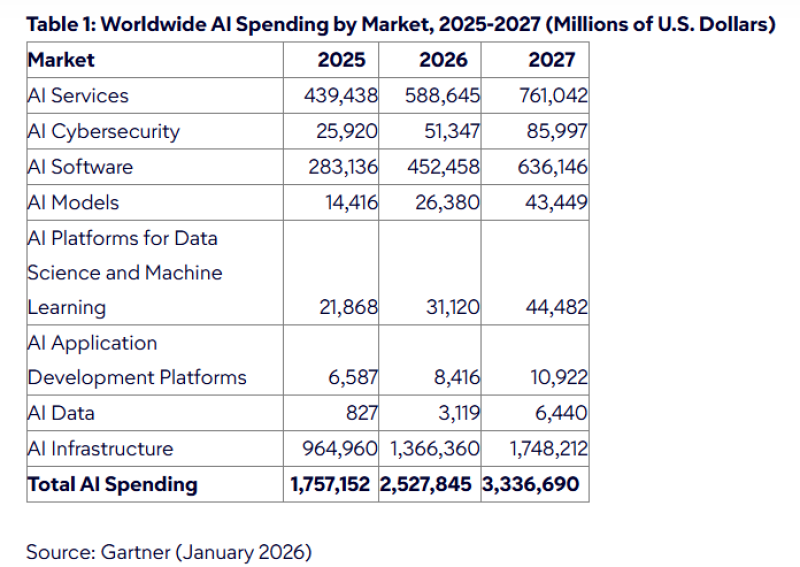
The largest spending category remains AI infrastructure, expected to exceed $1.36 trillion in 2026. AI software spending is forecast to reach $452 billion, while spending on AI services is expected to approach $589 billion.
Perhaps most notably, spending on AI models themselves is projected to rise from $14.4 billion in 2025 to $26.4 billion in 2026, highlighting the growing importance of foundation-model providers within enterprise technology budgets. The data suggest that multiple AI companies can continue expanding simultaneously as businesses allocate larger portions of their technology spending to AI-driven tools and services.
Claude Has Become a Strong Competitor in Software Development
Anthropic's momentum may also be linked to its growing reputation among developers. Recent SWE-bench rankings place Claude 4.5 Opus at the top of the benchmark with a 76.8% problem-resolution rate, ahead of several competing frontier models. OpenAI's GPT-5.2 Codex recorded 72.8%, placing it among the leading models but below Anthropic's flagship offering.
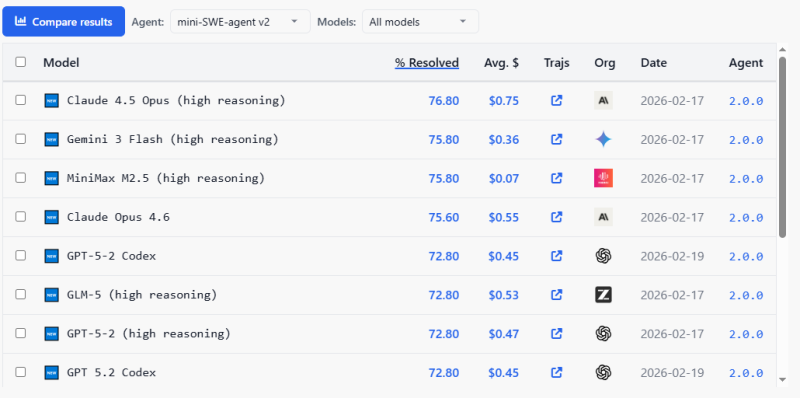
Software engineering remains one of the most commercially valuable applications of generative AI. Organizations increasingly deploy AI tools for code generation, debugging, documentation, testing, and workflow automation. Strong benchmark performance does not guarantee commercial adoption, but it often influences evaluation decisions among enterprise customers and engineering teams.
As a result, Anthropic's rise may reflect a broader shift toward developer-focused workloads where coding performance and reasoning capabilities play a particularly important role.
The AI Race Is Entering a New Phase
The Ramp data suggest that the enterprise AI market is becoming increasingly competitive. While OpenAI remains a major force, businesses appear more willing than ever to adopt multiple providers and evaluate models based on task-specific performance.
At the same time, overall AI adoption continues to rise, global spending forecasts remain exceptionally strong, and new competitors continue entering the market.
Anthropic's lead over OpenAI is currently narrow, but the significance of the milestone extends beyond market share. It signals that the next stage of the AI race may be determined less by consumer popularity and more by enterprise productivity, software-development performance, and the ability to solve real business problems at scale.
 Usman Salis