
 Artem Voloskovets

Every financial technology follows a similar path. At first, attention centers on price and speculation. Later, the focus shifts toward regulation, infrastructure, adoption, and sustainable business models. Price eventually becomes a consequence rather than the story itself.
Recent comments from Grayscale's Head of Research, Zach Pandl, point to several developments that suggest digital assets may be entering that next stage.
From Regulatory Risk to Regulatory Framework
The significance of the proposed CLARITY Act isn't that it favors cryptocurrencies. Its importance lies in something far more practical: defining how digital assets fit within the U.S. financial system.
Uncertainty has surrounded fundamental questions.
- Which assets fall under SEC oversight?
- Which belong to the CFTC?
- How should token issuers, exchanges, and blockchain networks operate under existing financial regulation?
Those questions matter because capital rarely commits to infrastructure when the rules remain unclear.
According to Pandl, the CLARITY Act could become the industry's most important catalyst not because legislation immediately changes markets, but because predictable regulation allows institutions to plan years ahead instead of quarter by quarter.
Banks, custodians, exchanges, payment companies, and asset managers typically invest only after legal uncertainty begins to disappear. That shift often matters more than market sentiment.
Tokenization Is No Longer a Pilot Project
Blockchain's fastest-growing application is no longer cryptocurrency itself. It is the tokenization of traditional financial assets.
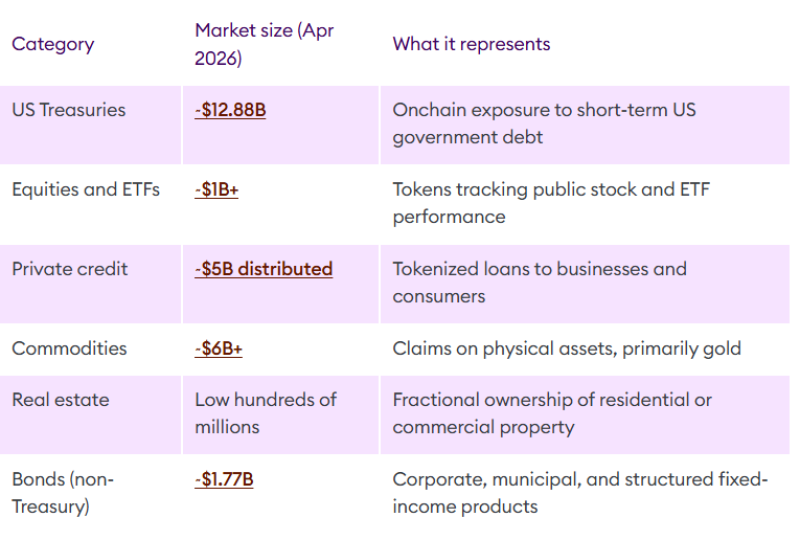
The latest figures show how far this market has already developed.
- US Treasuries: approximately $12.88 billion
- Commodities: more than $6 billion
- Private Credit: roughly $5 billion
- Corporate Bonds: approximately $1.77 billion
- Equities & ETFs: over $1 billion
- Real Estate: several hundred million dollars
Combined, more than $25 billion in real-world assets already exist on blockchain networks. The number itself is impressive. More important is what those assets represent.
Government debt, corporate credit, exchange-traded products and commodities are beginning to use blockchain as settlement infrastructure rather than as an experimental technology.
That is a different kind of adoption than previous crypto cycles. It reflects changes in financial plumbing rather than investor enthusiasm.
Ethereum Benefits From the Direction of Travel
This broader transition explains why Grayscale continues to maintain a constructive long-term view on Ethereum. The firm's thesis is increasingly infrastructure-driven.
Stablecoins, tokenized Treasury products, private credit funds and on-chain settlement applications continue to concentrate around Ethereum because liquidity, developer activity, security and institutional tooling are already deeply established there.
Ethereum doesn't necessarily need to dominate every blockchain category. If tokenization continues expanding, remaining the primary network where financial assets are issued, transferred and settled could prove far more valuable than winning every technical comparison.
The larger tokenization market becomes, the stronger Ethereum's network effects may become alongside it.
Revenue Changes the Conversation
Another sign of industry maturity is the growing importance of operating performance. Markets built entirely on narratives eventually begin measuring businesses by revenue. Crypto appears to be reaching that point.
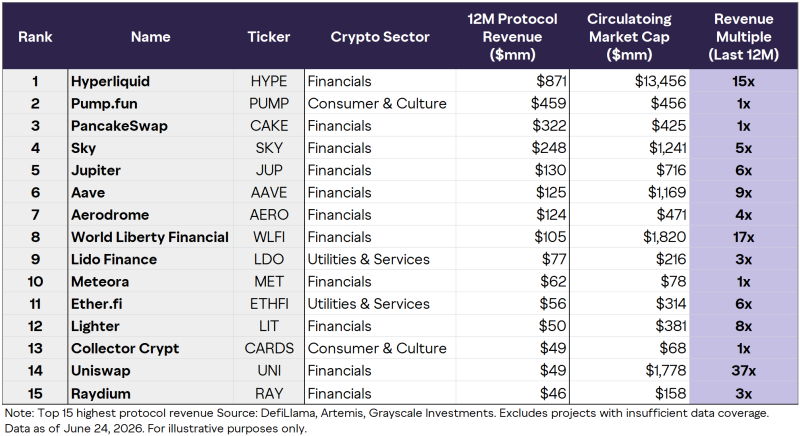
The latest protocol rankings highlight how quickly the landscape is evolving. Hyperliquid generated approximately $871 million in annual protocol revenue. Pump.fun followed with $459 million, while PancakeSwap reached $322 million. Sky generated $248 million, Jupiter $130 million, and Aave $125 million.
Several protocols now report annual revenues exceeding $100 million while trading at valuation multiples ranging from 1x to 15x, levels increasingly comparable to traditional software companies.
This represents an important shift. The discussion is gradually moving away from token prices toward cash flows, user activity and business fundamentals. That is how mature technology sectors are typically evaluated.
Where AI Fits
Grayscale also identifies AI-focused crypto networks as one of the industry's largest asymmetric opportunities. The connection between artificial intelligence and blockchain is increasingly practical.
Decentralized computing networks, autonomous AI agents, distributed datasets and machine-learning infrastructure all require systems capable of handling ownership, payments and economic coordination.
Blockchain technology naturally provides those functions. Whether today's AI protocols ultimately become dominant platforms remains uncertain. What already appears clear is that blockchain's addressable market is expanding well beyond digital finance.
The industry's next growth phase may involve enabling entirely new digital infrastructure rather than simply supporting financial transactions.

Looking Beyond the Next Market Cycle
The most meaningful changes in crypto today are happening beneath the surface. Regulation is becoming more defined. Traditional financial assets are steadily moving on-chain. Revenue-producing protocols increasingly resemble operating businesses.
Blockchain infrastructure is expanding into industries beyond finance, including artificial intelligence. None of these developments alone signals the end of crypto's experimental phase.
Taken together, however, they describe an industry that is becoming progressively more integrated into the architecture of global finance. If previous cycles were defined by speculation, the next one may be defined by infrastructure.
 Artem Voloskovets



