Marina Lyubimova
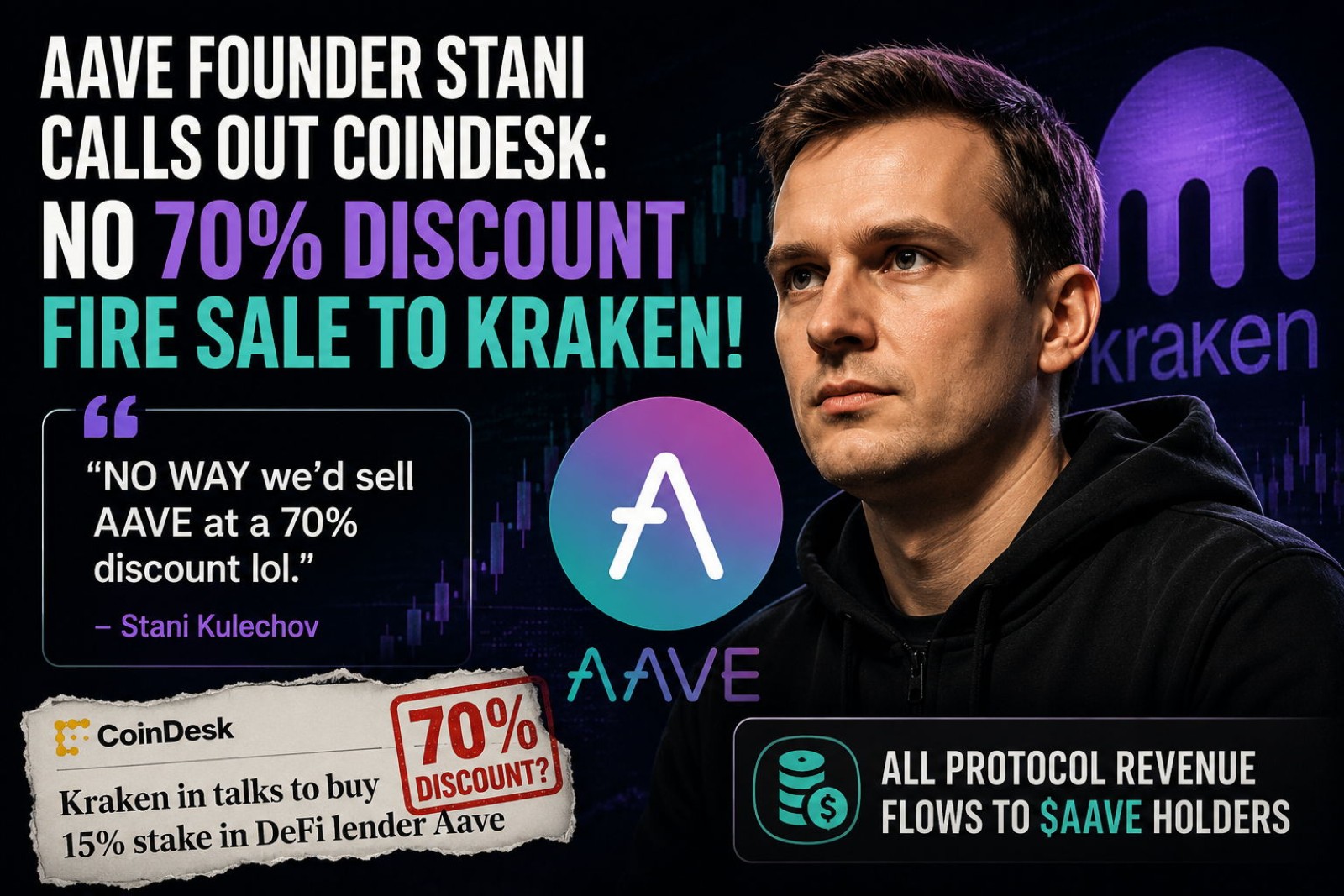
Reports claimed Aave Labs was preparing to sell AAVE tokens to Kraken at a discount of roughly 70%. Stani Kulechov responded almost immediately:
NO WAY we'd sell AAVE at a 70% discount lol.
The denial settled one question, but it exposed another. Why does the market react so aggressively whenever treasury tokens enter the conversation?
Why a Single Word Changed the Story
The report described a discounted sale. Kulechov described something entirely different: discussions around market participants potentially acquiring part of Aave Labs' token allocation through deeper strategic partnerships.
Those scenarios have little in common. A discounted sale is usually interpreted as a search for liquidity. It raises expectations of additional supply entering the market and creates concerns about insider confidence.
A strategic allocation has a different objective. Instead of raising cash, it can expand the network by aligning institutions, infrastructure providers, or ecosystem partners with the protocol's long-term growth. The distinction isn't semantic it changes how investors price risk.
Treasury Moves Have Become Market Signals
Only a few years ago, DeFi investors focused on TVL, lending volume, and user growth. Today, treasury management attracts just as much attention. Markets increasingly evaluate how protocols deploy reserves, whether insiders remain aligned with token holders, and how future supply could affect circulating tokens.
That shift explains why an unconfirmed report can trigger immediate debate long before any transaction actually occurs. The headline wasn't moving the market because of Kraken. It was moving the market because of perceived supply.

Where the Investment Thesis Actually Sits
Kulechov's most important statement received far less attention than his denial. All protocol revenue flows to AAVE holders. That single point reinforces the investment case behind the protocol.
As lending activity expands, the long-term discussion becomes less about token unlocks and more about whether protocol cash flows continue growing alongside network usage. For mature DeFi protocols, sustainable revenue is gradually replacing speculation as the metric investors care about most.
Communication Has Become Part of Token Economics
The market punished plenty of crypto projects in previous cycles because treasury decisions were poorly explained or explained too late. As a result, investors now assume the worst whenever founder allocations or treasury wallets appear in headlines.
The faster teams clarify the purpose behind token movements, the smaller the gap between perception and reality. That makes communication an extension of treasury management rather than a separate function.
The Real Story
The rumor itself may disappear within days. The market behavior probably won't. Every treasury decision is now interpreted as a signal about future supply, founder conviction, and protocol health. Kulechov rejected the idea of a 70% discounted sale, but the broader lesson extends well beyond Aave. For DeFi's largest protocols, capital allocation is no longer viewed as an operational decision. It has become part of the investment narrative itself.
 Marina Lyubimova