Sergey Diakov

Not many people can say they spent their teens hauling salmon nets at 4:30 in the morning and their forties headlining stadiums of 100,000 people. Michael Buble can. His story is genuinely unusual: a decade of near-total obscurity, one lucky wedding gig, and then one of the steadiest climbs in modern pop music. Today, michael buble net worth sits at around $90 million and keeps growing. But the number only makes sense if you understand where it started.
Michael Buble's First Dollars: Nightclubs at 16 and $20 a Night

Buble grew up in Burnaby, British Columbia, in a tight-knit working-class family. His dad fished for salmon, and for six straight summers as a teenager, Michael went along for the ride, working brutal 4:30 a.m. to 11 p.m. shifts on the boat. Jazz, though, was always louder than the ocean. His Italian grandfather Demetrio was a plumber who had a simple system: he would fix the pipes at local nightclubs for free, as long as the owners let his grandson sing a few songs. Those early gigs paid about $20 a set.
At 18, Buble entered a local talent contest, won it, and was immediately disqualified for being underage. He entered the Canadian Youth Talent Search instead and won that too. After taking the 1995 PNE Youth Talent Search title in Vancouver, he landed a spot at a jazz club called Rossini's. The fee was $50. He would later describe it as "big-time money," and he wasn't joking.
10 Years of Grind Before Anyone Noticed
Through the late 1990s, Buble played every room that would have him: clubs, hotel lounges, cruise ships, conventions, shopping malls. He put out three indie albums on his own dime: First Dance in 1996, BaBalu in 2001, and Dream in 2002. None of them made a dent. On the side, he delivered singing telegrams and even picked up a tiny bit part on The X-Files purely because he needed the money. By 2000, he was seriously thinking about quitting music and going into journalism.
Then came the one break that changed everything. A corporate gig led to an invitation to sing at the wedding of former Canadian Prime Minister Brian Mulroney's daughter. Grammy-winning producer David Foster was in the room. Foster signed Buble to his 143 Records label in 2001. Labels tried to get Buble to change his name. He refused, and Warner Brothers backed down.
The Breakthrough Years: From Unknown to Billboard No. 1 Between 2003 and 2009

Buble's self-titled debut came out in February 2003. It hit the Top 10 in Canada, the UK, and South Africa, and topped the charts in Australia. He won New Artist of the Year at the 2004 Juno Awards. His follow-up, It's Time (2005), reached No. 1 in Canada, Japan, and Italy, and sold over 2.8 million copies in the US. The single "Home" became the most-played song on Canadian radio that year, estimated to have reached 382 million listeners.
Call Me Irresponsible (2007) debuted at No. 1 on the US Billboard 200 and topped charts in nine countries, pushing his total sales past 15 million copies. Then came Christmas in 2011, which became the best-selling holiday album in Australia for years and a permanent presence on seasonal charts everywhere. It earns fresh royalties every December without Buble recording a single new note.
Michael Buble Net Worth in 2025: $90M and Multiple Income Streams
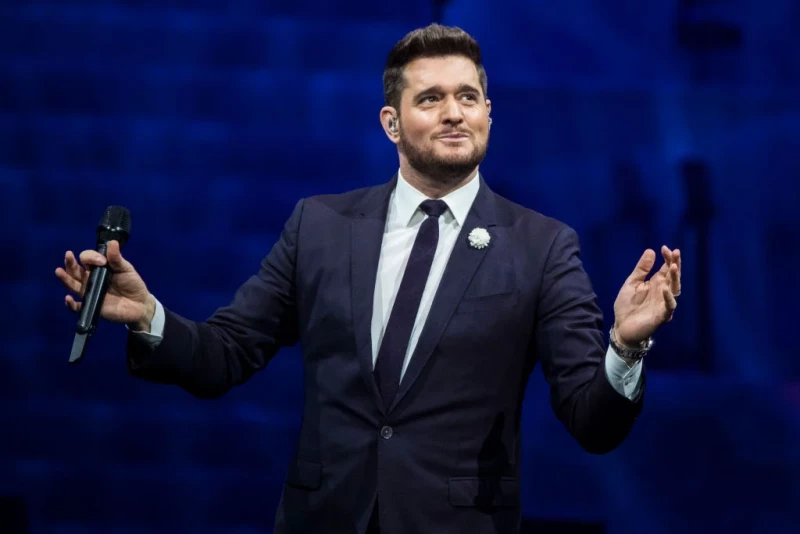
As of 2025, michael buble net worth is estimated at $90 million, up from $80 million in 2023 and $86 million in 2024. He has sold over 75 million records, won five Grammy Awards and 15 Juno Awards, and draws royalties from a catalog of 10 studio albums. The Christmas album alone is estimated to generate between $1.7 and $2.1 million per month during the holiday season.
Live touring is still his biggest earner. He regularly sells out arenas, and once drew 100,000 people to a single show at Aviva Stadium in Dublin. Beyond music, he holds endorsement deals with Starbucks, Rolex, and Pepsi, and owns real estate in British Columbia, Los Angeles, and Argentina. A coaching role on NBC's The Voice added another revenue stream in recent years. Independent social media estimates put his monthly cross-platform earnings between $1.7 and $2.1 million.
What Buble Actually Believes About Success

Buble is unusually straight about what it took to get here. He never chased trends: while labels told him jazz was dead and nobody wanted that sound in the hip-hop era, he just kept recording the music he grew up loving. He approaches cover songs as the hardest possible creative challenge, not the easiest. He put it plainly: "My job isn't to sing it better than Sinatra. My job is to make it my own." He never stopped performing live, even in near-empty rooms. All that stage time built the audience loyalty that eventually filled stadiums.
The most public version of his values came in 2016, when his son Noah was diagnosed with liver cancer. Buble stepped away from music entirely. No tours, no albums, no press. His return a couple of years later was met with the kind of fan response that money can't manufacture. He has talked about resilience the way he once talked about that $50 gig at Rossini's: "If I miss the stars, I'll hit the moon, and that's still pretty high." For a kid who started at $20 a night, $90 million looks a lot like the moon.
 Sergey Diakov