Peter Smith

Zeta Global is flashing one of the more unusual setups in the software sector right now. While the share price has slid to around $18.40, algorithmic flow data tells a completely different story - one that has traders paying close attention.
AlgoFlow Surges to 175,000 as Price Drops
Trading data shows the AlgoFlow indicator for ZETA climbing sharply to roughly 175,000 - the highest reading on the chart - even as the stock moved lower. For most of the tracked period, the green indicator oscillated near zero, reflecting no sustained directional bias. The recent spike breaks that pattern dramatically. This kind of divergence often appears when institutional players are absorbing shares from weaker sellers rather than exiting their own positions.
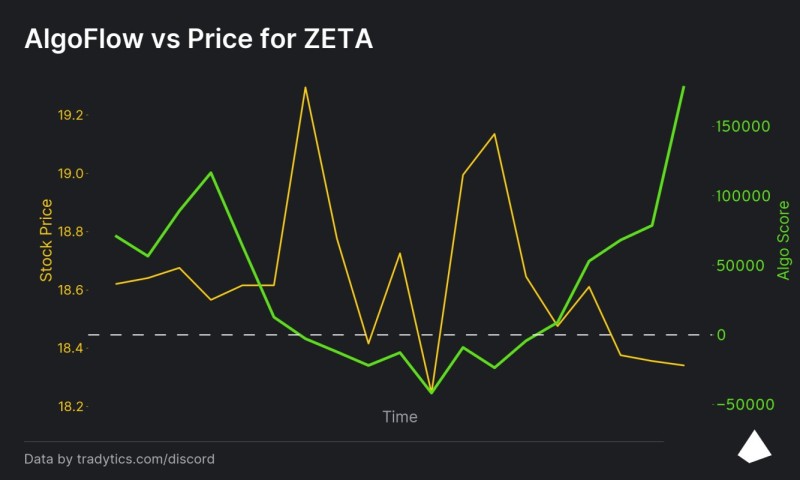
In market flow analysis, rising institutional activity against falling price is interpreted as quiet accumulation. Large participants rarely telegraph their moves through price alone - flow data is one of the few windows into what they may actually be doing.
ZETA at a Structural Crossroads
Zeta Global runs a machine learning-powered marketing automation platform that helps brands predict consumer behavior and optimize digital campaigns. Analyst consensus generally leans constructive, with price targets implying meaningful upside from current levels. But the stock has been volatile as the broader SaaS space deals with macroeconomic headwinds and shifting sentiment.
Recent coverage captures this tension well. Zeta Global Tests $15-$16 Support as Tech Stocks Slide Persists highlighted key downside zones during broader SaaS weakness. At the same time, Zeta Global Stock Builds Tight Structure Ahead of 2026 Focus pointed to a tightening price pattern that could define the next major move. And ZETA Stock Drops 10% After Breaking Below 20-Day Moving Average documented how technical breakdowns have added to near-term volatility.
The question now is whether the AlgoFlow spike at $18.40 marks the start of a genuine institutional accumulation phase - or just a brief blip. Flow divergences like this don't always resolve to the upside, but they rarely go unnoticed for long.
 Peter Smith