Eseandre Mordi
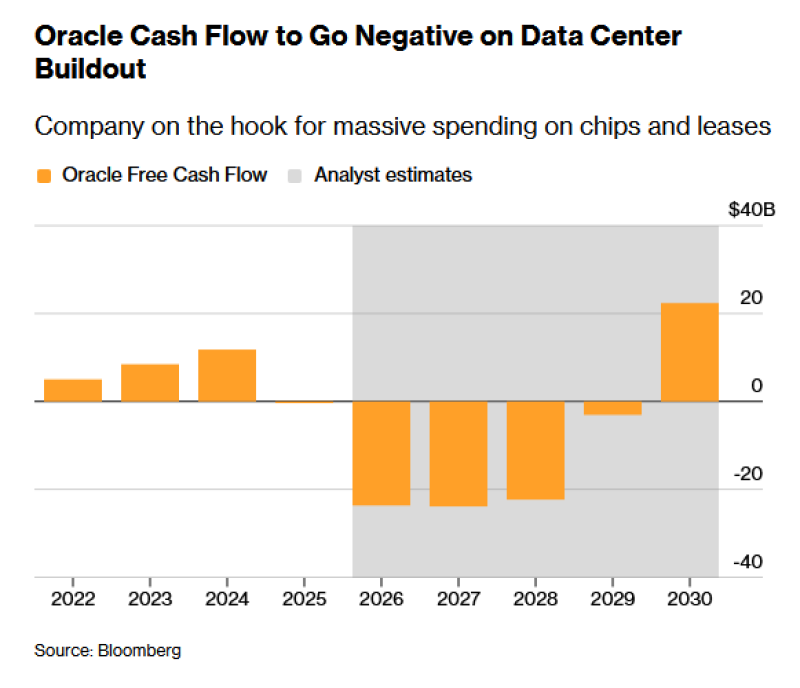
Oracle Corporation (NYSE: ORCL) is in the middle of one of the most ambitious spending cycles in its history. The company is scaling up data centers, securing advanced chips, and signing long-term infrastructure leases at a pace that is pushing its free cash flow to roughly negative $13 billion — the first time in two decades Oracle has landed in negative territory. What looked like a one-off in 2024 now appears to be a multi-year feature of the company's financial profile.
Analyst projections show that Oracle's free cash flow was solidly positive from 2022 through 2024, then flattened in 2025, and is expected to stay below zero from around 2026 through 2028. The culprit is straightforward: building large-scale AI data center infrastructure is expensive. Computing hardware, power capacity, cooling systems, and campus-level facilities all carry serious price tags, and Oracle is committing to all of them at once.
The financial shift is a direct result of Oracle's decision to compete more aggressively in cloud and AI compute, a market currently dominated by Amazon Web Services and Microsoft Azure. To close the gap, Oracle needs infrastructure at scale — and that means spending now to earn later. The company is betting that enterprise demand for AI workloads will be large enough, and sticky enough, to justify years of negative cash flow during the buildout phase.
Credit Risk Climbs as Capital Commitments Grow
The scale of the commitment is drawing attention beyond equity markets. Oracle's credit risk indicators have reached their highest levels in 16 years, reflecting concern about how much capital the company is locking into long-horizon AI infrastructure projects — with a significant portion of that exposure tied to a single large customer. Credit markets, which tend to be less forgiving than equity investors on questions of leverage and concentration risk, are watching closely.
For Oracle, the next few years will be defined by how well it can manage this transition without eroding confidence. The company is making a decade-scale bet that cloud and AI infrastructure will be the center of enterprise computing — and it is paying for that bet upfront, in cash, right now.
 Eseandre Mordi