Artem Voloskovets

Shares of Meta Platforms, Inc. are under heavy pressure, falling more than 9% and trading around $605.80. The decline places the stock near the lower end of its 52-week range, signaling a clear shift in sentiment.
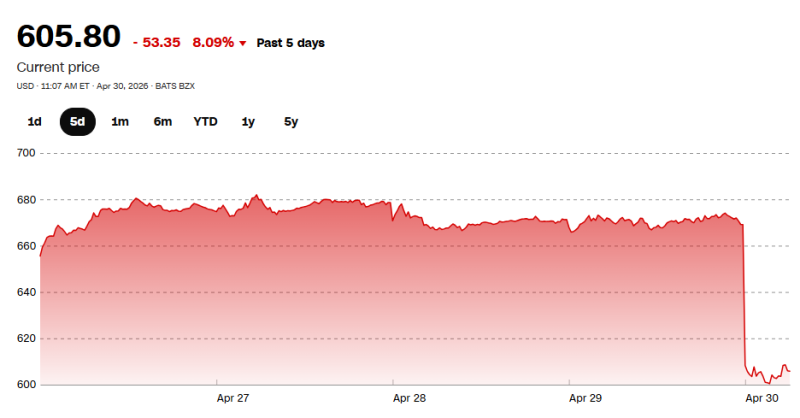
The move started with a sharp gap down at the open. META opened at $619.40, about $49.72 below the previous close, indicating aggressive selling from the start of the session. Overall, the stock has dropped roughly $63.09 since the last close.
The sell-off appears to be driven by a combination of factors rather than a single catalyst. A key driver is technical pressure, as the stock has now broken below its 200-day simple moving average, a level widely watched by institutional investors. Such breaks often trigger additional selling from algorithmic strategies and trend-following funds.
At the same time, the magnitude of the gap down suggests institutional repositioning or a reaction to new information, which can accelerate downside moves. In broader terms, declines of this scale in large-cap tech stocks are often linked to changing expectations around growth, earnings outlook, or macro conditions, even if a single headline is not immediately visible.
The chart also shows a rapid move from the $670–$680 range earlier in the week to near $600, highlighting the intensity of the selling pressure and a shift from gradual decline to accelerated downside.
What This Drop Means
The sell-off comes despite a recently bullish analyst view, where Guggenheim reaffirmed a Buy rating on Meta with a price target of $850, citing strength in advertising and long-term AI potential. However, that outlook also highlighted risks related to elevated capital spending and pressure on margins. This contrast suggests that even with strong long-term expectations, investors remain sensitive to near-term uncertainty, especially around cash flow and execution. As noted in the Guggenheim reaffirms Buy on Meta with $850 target, the company’s growth story remains intact, but the path toward monetizing AI investments is still a key question for the market.
A decline of more than 9% in a mega-cap stock like Meta Platforms, Inc. can have broader market implications. Such moves often impact overall sentiment in the technology sector, especially when the stock is a major component of large indices.
The break below the 200-day moving average may also lead to further technical selling, as some institutional strategies reduce exposure when long-term support levels fail. This can increase short-term volatility and create additional downside pressure.
At the same time, sharp declines like this often reset positioning. If selling stabilizes near key levels such as $600, the stock could attract dip buyers looking for long-term entry points, which may lead to a rebound.
 Artem Voloskovets