Usman Salis

With February 20 expiration approaching, AST SpaceMobile is caught between put-heavy protection on the downside and a thick wall of call interest above — and the $90 strike is quickly becoming the line in the sand.
Put Side Shows Protection, Not Panic
AST SpaceMobile is hovering around $81.50, sitting just below what options analysts are calling a significant magnet level heading into expiry. According to ASTS whale options flow analysis, put open interest is spread across strikes from the $20s up through the mid-$70s, but it tapers off as you get closer to the current price. That pattern reads more like hedging than a fresh directional short bet — traders protecting existing long positions, not piling in to bet against the stock.
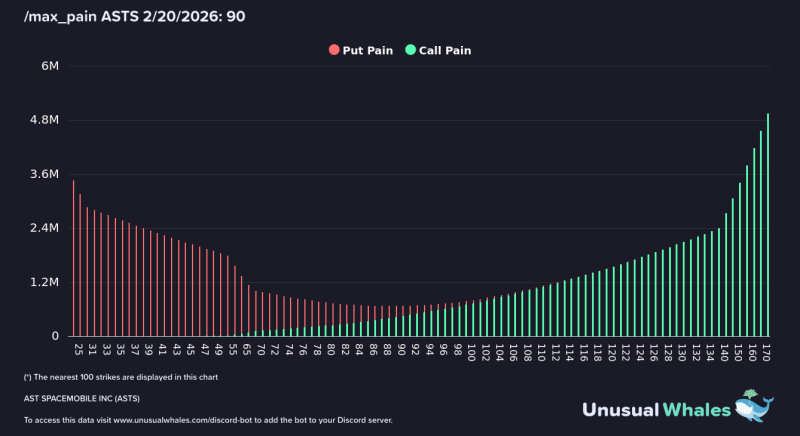
Just above spot, the dynamic shifts. Calls begin to dominate, marking the point where market sensitivity starts tilting toward the upside. This transition zone is a key feature of the current ASTS options call positioning setup and explains why the $90 area is getting so much attention.
A push into the high $80s followed by acceptance above $90 could intensify hedging flows and shift price behavior toward higher strike clusters where call interest is denser.
What the $90 Strike Means for ASTS Price Action
Above $90, call exposure builds sharply and thickens further from $100 through higher strikes — a steep, call-heavy ramp that creates a self-reinforcing dynamic. If price pushes into the high $80s and holds above $90, dealer hedging flows could accelerate the move, pulling price toward denser strike clusters. This is the mechanics behind ASTS max pain levels and why the $90 strike carries such weight into this expiry window.
How the market reacts near $90 over the next few sessions will be telling. Either the strike acts as a cap, keeping ASTS rangebound into expiry, or it becomes a launchpad for a higher-volatility phase driven by positioning dynamics and forced hedging. Either way, the setup is worth watching closely.
 Usman Salis