Marina Lyubimova

⬤Crude oil is back in the spotlight after recording one of its biggest weekly spikes since the early 1980s. Energy markets are reacting fast to rising geopolitical tensions and mounting supply concerns, sending USOIL sharply off recent lows. On the long-term chart, the rebound is now heading toward a structural resistance level that has defined the market for nearly two decades.
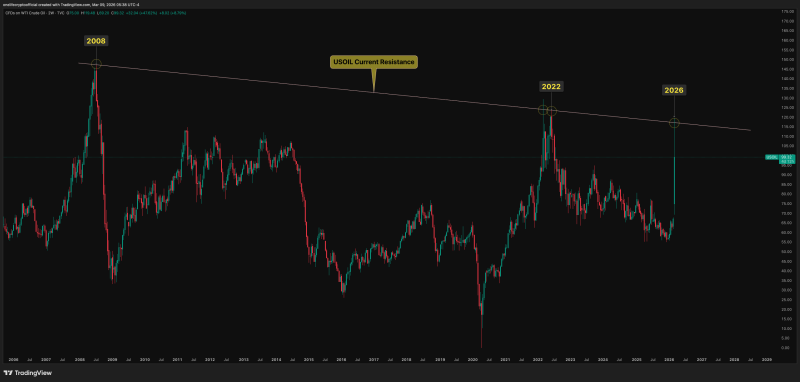
⬤That resistance takes the form of a descending trendline connecting the two most significant crude oil peaks in recent memory — the 2008 commodity supercycle top and the 2022 energy crisis spike. Both moments marked major turning points for global oil prices. The current rally puts USOIL on a potential path toward testing that same ceiling again, with technical projections pointing to the $110–$120 zone where the trendline currently sits.
⬤This isn't the first time geopolitical shocks have triggered rapid repricing in crude. As covered in WTI Oil Breaks $84: Key Resistance at $87 and $95 Now in Focus, oil surged past $84 as tensions escalated, with traders quickly pivoting to watch the next cluster of resistance levels. Price action in those situations tends to be aggressive once key levels are breached.
⬤Technical momentum in crude often accelerates faster than expected after a reclaim of key zones. That dynamic was outlined in WTI Oil Price Analysis: Crude Breaks $65.39, Eyes $68–$69 Level, which tracked how quickly oil moved toward the next target once resistance flipped to support. The current setup carries similar characteristics.
⬤The broader energy picture was also laid out in USOIL Crude Oil Rally Resumes With $77.64 Resistance in Focus, where analysts pointed to recurring Middle East supply disruptions as a persistent driver of sharp rebounds. With USOIL now approaching the long-term descending resistance that capped both 2008 and 2022, how price reacts at that zone could determine the next major directional move across global energy markets.
 Marina Lyubimova