
 Saad Ullah

U.S. banks have quietly built up nearly $300 billion in exposure to the private credit sector, and the numbers keep climbing. According to data from the Federal Reserve and Moody's Ratings as of June 2025, the lending ties between traditional banks and alternative credit funds have grown into one of the more consequential structural shifts in modern finance. US banks' exposure to private credit hits $300bn - that threshold reflects how deeply intertwined the two sectors have become.
WFC Tops the List: Which Banks Hold the Most Private Credit Risk
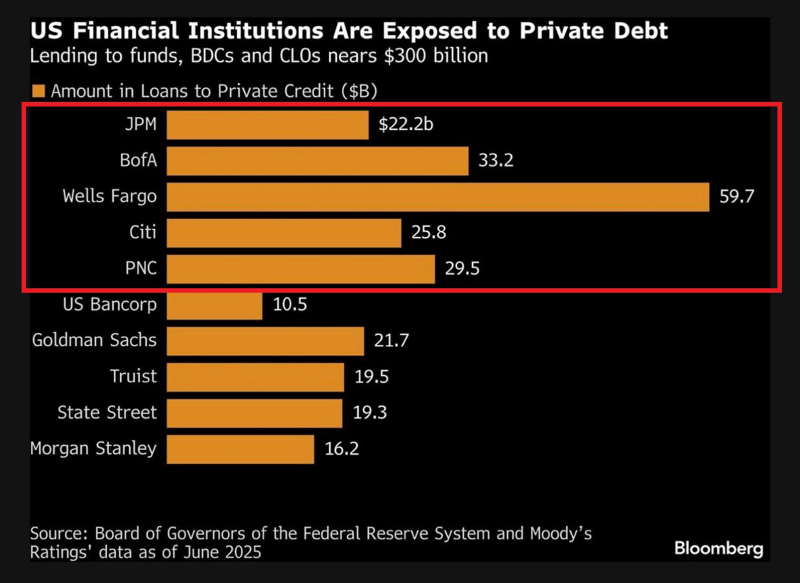
Wells Fargo (WFC) sits at the top with $59.7 billion in loans tied to private credit funds, business development companies (BDCs), and collateralized loan obligations (CLOs). Behind it:
- Bank of America at $33.2B
- PNC at $29.5B
- Citigroup at $25.8B
- JPMorgan Chase at $22.2B
- Goldman Sachs ($21.7B)
- Truist ($19.5B)
- State Street ($19.3B)
- Morgan Stanley ($16.2B)
- U.S. Bancorp ($10.5B) round out the field.
The spread is wide, but the direction is the same across every name on that list - up.
Back Leverage, Yield Chasing, and What Happens If Banks Pull Back
Private credit funds typically rely on a mechanism called back leverage - borrowing against their own loan portfolios to juice returns. It works well in stable conditions, but it also means the funds need banks to keep lending. If that support contracts, the math on those double-digit yields starts to break down fast, and investor withdrawals could follow. That dynamic is explored in depth in Private Credit vs. Bank Loans: How Non-Bank Lenders Are Powering the Next Era of Real Estate Financing.
Leverage can boost yields from roughly 8-9% into double-digit levels - but it also creates a hard dependency on continued bank financing.
Over the past decade, private credit has grown from a niche corner of finance into a multi-trillion-dollar global market. Banks have moved from competitors to enablers - providing the capital infrastructure that lets alternative lenders operate at scale. For investors thinking about allocation, Alternative Asset Investing Strategies for Modern Portfolios outlines where private credit fits in a broader strategy. The closer these two worlds get, the more any disruption in one will ripple through the other.
 Saad Ullah



