Artem Voloskovets

The latest data marks not just a cyclical dip but a decisive break below prior lows - a move that is increasingly difficult to attribute to short-term noise.
As reported by Barchart, the dollar's share has now slipped into the low-40% range, extending a downtrend that has defined global reserve dynamics since the early 2000s.
A Downtrend Decades in the Making
The long-term chart tells a clear story. From above 60% in the early 2000s, the dollar's reserve share has moved steadily lower through a sequence of lower highs and lower lows - the textbook structure of a sustained downtrend rather than a temporary pullback.
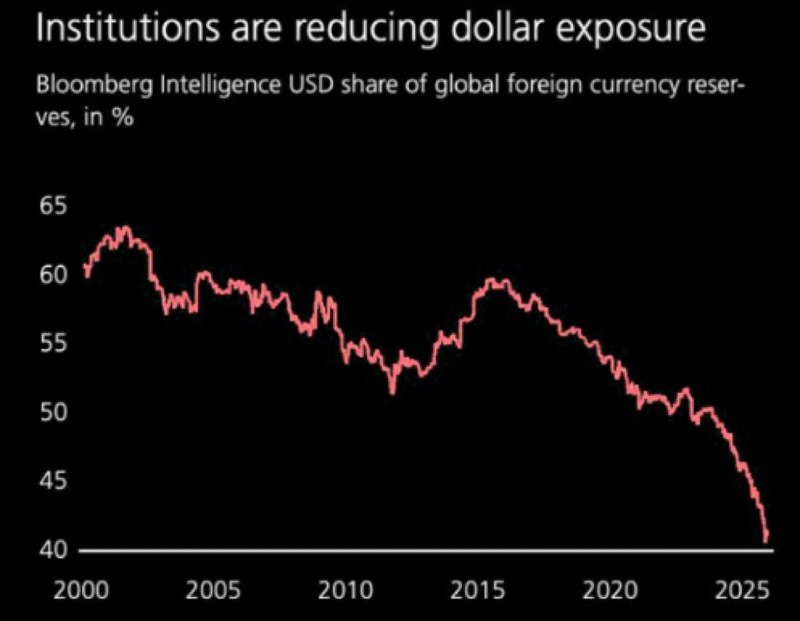
The dollar's share is not just fluctuating - it is trending lower over time, and the pace of that decline is picking up.
For much of the 2005-2020 period, the metric held within a broad consolidation range between roughly 55% and 60%. That range has now been decisively broken, with the current reading pressing toward the 40% level - which now becomes the next major structural reference point.
The breakdown in structure is visible across multiple timeframes. Key technical observations from the chart include:
- A failure to hold above the mid-50% zone
- A sequence of lower peaks stretching back to the mid-2010s
- A sharp breakdown below 50%, followed by continued downside
This is no longer range-bound behavior. The transition into a more directional decline accelerated through the most recent leg lower, with the 40% threshold now squarely in focus.
What stands out is not just that the dollar is losing share - it is losing it faster than at any prior point in this cycle.
A One-Sided Move With Weak Recoveries
The character of the price action within this trend has shifted meaningfully. Earlier phases of the decline featured genuine recoveries - meaningful countertrend moves that temporarily interrupted the downtrend.
That pattern has broken down:
- Rebounds are becoming shorter in duration and smaller in scale
- Each recovery attempt fails below the level of the previous high
- The latest leg lower has shown accelerated momentum with no clear base forming
This asymmetry - stronger moves to the downside, weaker responses to the upside - is a hallmark of a trend gaining rather than losing momentum.
The reserve data does not exist in isolation. Parallel trends in central bank behavior point in the same direction, suggesting a coordinated structural reallocation rather than isolated portfolio shifts.
Central Bank Gold Holdings Hit 20% of World Reserves - gold's share of global reserves has climbed to multi-decade highs, with central banks consistently adding to positions as dollar allocations shrink.
Central banks are not reacting to short-term volatility. They are repositioning for a different global reserve landscape.
Alongside that, Central Banks' Gold Reserves Surpass U.S. Treasuries - a threshold that would have been considered unlikely just a decade ago, now a matter of record.
And more broadly, Central Banks Push Gold Reserves to Highest Level in Decades - reinforcing that the move away from dollar-denominated assets reflects a deliberate, long-term strategy playing out across institutions globally.
Taken together, the picture is consistent: the dollar's century-low reserve share is part of a larger structural story - one that the data suggests is still in progress.
 Artem Voloskovets