Marina Lyubimova

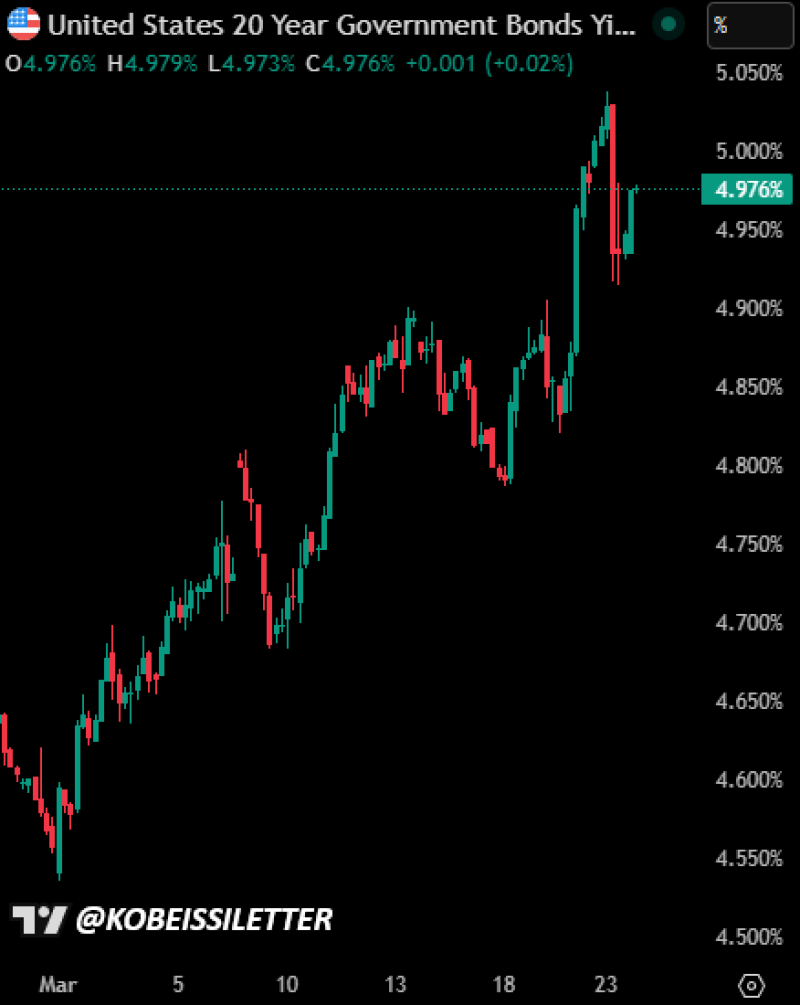
The US 20-Year Treasury yield has surged back to the 5.00% mark in less than 24 hours, alarming fixed income traders who expected bond markets to ease. The move arrived despite renewed talk of potential peace negotiations, showing that bond markets are moving on their own terms, independent of geopolitical headlines. Charts tracking March activity show a steady climb from around 4.55% earlier in the month to the current 5.00% threshold, with volatility picking up sharply at recent highs.
Rising Yields Push Mortgage Rates Toward 7% and Gas Prices Near $4.00
This kind of yield acceleration does not stay abstract for long. Higher rates on long-dated Treasuries have already fed through into consumer borrowing costs, with mortgage rates approaching 7% and gasoline prices creeping toward $4.00 per gallon. Together, these figures tighten household budgets at a time when inflation expectations remain stubbornly elevated. The 20-year yield acts as a bellwether for long-term financial conditions, and its return to 5% reinforces that borrowing costs are not retreating any time soon.
Why 5% on US20Y Matters for Economic Stability
Analysts watching the trajectory point to a broader pattern across global sovereign debt. The US 10-Year yield hitting 5.23% as the Fed rate cut cycle stalled was one signal; the UK 10-Year yield topping 5% for the first time since 2008 was another. The US20Y crossing 5% fits the same pattern of rising global borrowing costs placing structural pressure on liquidity conditions. When multiple major bond markets move in the same direction simultaneously, it rarely stays a financial story alone. It becomes a question of how governments, businesses, and households adjust to a more expensive credit environment over the months ahead.
 Marina Lyubimova