Saad Ullah

Something notable just happened in the bond market. The US 10-Year Treasury Yield slipped under the 4% mark, settling near 3.99%. It's a threshold traders watch closely, and crossing below it signals a meaningful shift in how markets are pricing the outlook for interest rates and economic growth.
From 4.30% Resistance to 3.99%: How the Yield Got Here
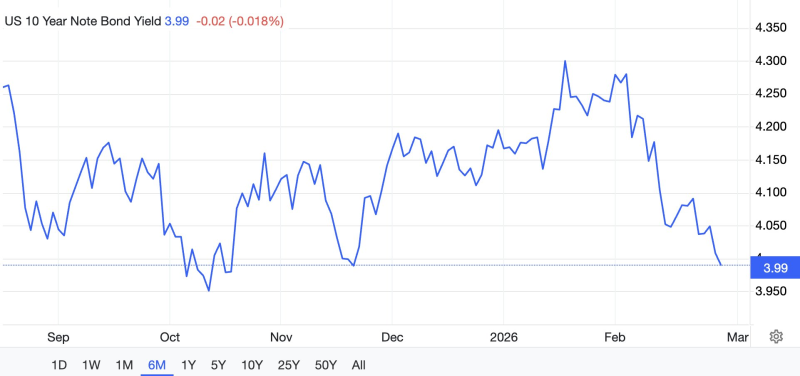
Over the past six months, the 10-year yield had been holding firm around the 4.20%-4.30% range, with multiple tests of that resistance zone in early 2026. The breakdown was gradual — a series of pullbacks and brief spikes that slowly wore down the upside momentum. As US 10-Year Treasury Yield drops below 4% for the first time in over a year, the move reflects a broader repricing of rate expectations, with investors increasingly betting that the Federal Reserve will ease monetary policy as inflation pressures moderate.
The direction of the 10-year yield has been a central driver of swings across bond markets, with yields reacting to inflation signals, macroeconomic data, and central bank policy expectations.
The US Treasury yield spread hitting 69 basis points as the curve steepens toward a 4-year high adds further context to where bond markets stand right now. A steepening curve alongside falling long-end yields typically points to growing confidence that short-term rates will come down — and that's exactly the narrative gaining traction.
Why the 4% Level Matters for Borrowing Costs and Risk Assets
The 10-year Treasury yield isn't just a number on a chart. It's the benchmark that feeds directly into mortgage rates, corporate borrowing costs, and the discount rates used to value equities. When it falls, credit conditions tend to loosen and valuations across risk assets tend to get a lift.
That dynamic is worth watching closely in the weeks ahead. As noted in coverage of how the 10-year yield forms bullish divergence ahead of CPI, the technical picture has been quietly shifting for a while. Whether yields stabilize near current levels or continue lower will depend heavily on upcoming inflation data and any signals from the Fed — but for now, the market has made its move, and the 4% floor has given way.
 Saad Ullah