Marina Lyubimova

Half a million BTC has left exchanges. According to Binance Research, Bitcoin exchange balances have fallen from 17.6% of total supply during the COVID-era peak to just 15.0% today - the lowest level in six years. That matters because exchange balances represent liquid supply.
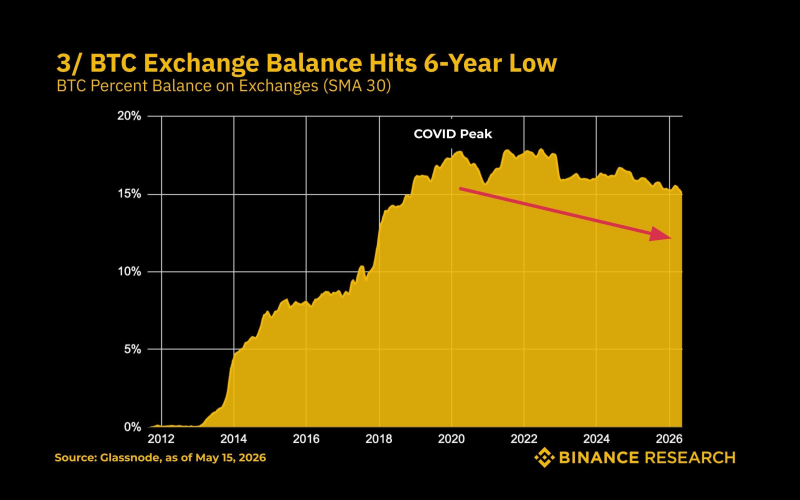
Bitcoin balances on exchanges have fallen to their lowest level in six years, according to Binance Research and Glassnode data. In previous crypto cycles, exchange outflows were often temporary. Coins moved into cold storage during bullish periods and eventually returned once profit-taking accelerated. This cycle looks different. A growing share of Bitcoin appears to be moving into structures designed for long-duration holding rather than active trading.
Bitcoin supply is becoming increasingly dormant
Part of the shift comes from ETFs. Spot Bitcoin ETFs moved large amounts of BTC into custodial systems that rarely behave like exchange wallets. Coins held inside ETFs effectively become less liquid because they are tied to slower institutional flows rather than active speculative trading. Another major factor is the rise of long-term holders.
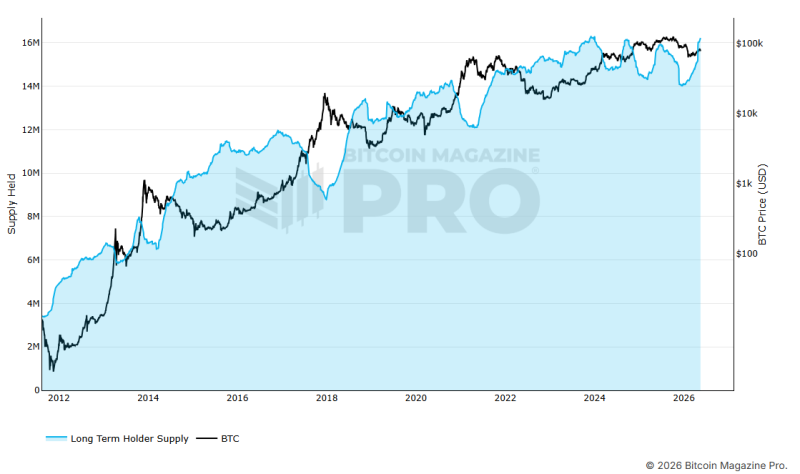
Long-term Bitcoin holder supply continues rising even as BTC trades near cycle highs. This second chart is important because it shows Bitcoin is not just leaving exchanges. It is becoming inactive.
A growing percentage of supply is now controlled by holders who historically sell less frequently and react less aggressively to volatility. That changes market structure. Bitcoin adoption is increasing while liquid supply keeps shrinking.
The market may still be pricing Bitcoin incorrectly
Crypto markets spent years operating around:
- exchange liquidity;
- leverage cycles;
- rapid speculative flows;
- short-term positioning.
But ETFs, institutional custody, and self-custody trends are starting to change those mechanics. A shrinking exchange balance does not guarantee higher prices. But it does mean fewer coins are realistically available if demand accelerates again. That becomes important because the market may still be treating Bitcoin as a highly liquid trading asset while part of the supply increasingly behaves like locked capital.
ETFs are changing Bitcoin’s circulation
Historically, Bitcoin moved constantly between exchanges, traders, leveraged positions, and speculative flows. ETFs change that. They absorb BTC into slower-moving financial structures tied to traditional capital markets. That reduces tradable supply while increasing the share of long-duration ownership. Speculative capital rotates quickly. Institutional allocation usually moves much slower. The result is a market where liquidity may be tightening underneath the surface even while mainstream adoption expands.
Self-custody is removing more supply from circulation
Another major driver is self-custody. After FTX, Celsius, and multiple exchange failures, many investors moved assets into cold storage permanently. Coins held in self-custody are less likely to react to short-term volatility or leverage-driven liquidations. That reduces available float further.
Bitcoin already operates with one of the most inelastic supply systems in global finance. New issuance keeps declining through halvings while a growing percentage of supply becomes inactive. Very few major assets behave like that.
Bitcoin may be becoming structurally scarcer
The market often talks about Bitcoin scarcity through the 21 million supply cap. But liquid scarcity matters more than theoretical scarcity.
If more BTC becomes:
- ETF-held;
- self-custodied;
- institutionally warehoused;
- long-term inactive;
Then the amount of Bitcoin realistically available for trading keeps shrinking. That does not guarantee a straight-line bull market. But it does suggest Bitcoin’s market structure may be becoming significantly tighter than many investors realize.
 Marina Lyubimova