Marina Lyubimova

- Why Freelancing Became the First Industry to Feel AI Pressure
- The Collapse of the Junior Career Ladder
- The Internet Is Becoming Too Polished to Feel Human
- AI Made Misinformation Scalable
- Shadow AI Is Already Embedded Inside Modern Companies
- AI Removed One Kind of Routine and Created Another
- AI Optimizes Execution, Not Human Development
- The return of human differentiation
- Conclusion
A few years ago, artificial intelligence still felt like a futuristic productivity experiment. Companies talked about eliminating repetitive work, employees imagined finally escaping endless administrative tasks, and investors framed AI as the beginning of a massive economic transformation comparable to the rise of the internet itself.
ChatGPT, Claude, Gemini, and dozens of other AI systems genuinely changed digital work faster than most analysts predicted. Writers began producing articles in a fraction of the time. Developers accelerated coding workflows with copilots and automated debugging tools. Designers generated concepts instantly. Marketing teams scaled campaigns that previously required entire departments. Small startups suddenly gained capabilities that once belonged only to large organizations with significant resources.
But somewhere beneath the excitement, another feeling slowly started emerging.
The internet became harder to trust. Content began sounding strangely similar. Employees became faster, yet more exhausted. Companies saved time while quietly losing something far more difficult to rebuild later: deep human expertise.
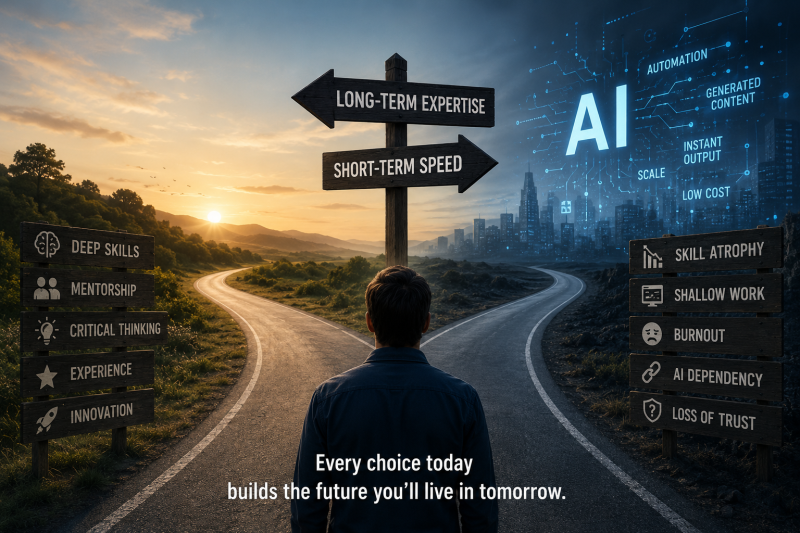
This is where a new problem starts to appear - something that can be described as AI Debt.
Technical debt has existed in software development for decades. Teams move quickly, release products faster, skip architectural discipline, and postpone difficult decisions in exchange for short-term growth. At first, the strategy works. Products ship faster and companies scale quickly. Eventually, though, the shortcuts become expensive. Systems become fragile, difficult to maintain, and increasingly unstable.
AI is beginning to create a similar dynamic, but the debt accumulating this time is not primarily technical.
Businesses are accelerating output while gradually weakening the systems that produce judgment, expertise, creativity, and long-term professional development. The consequences rarely appear in quarterly reports because they emerge slowly and unevenly. Employees stop deeply engaging with their work. Junior specialists disappear from hiring pipelines. Organizations lose visibility into how AI is actually being used internally. The internet fills with structurally identical content optimized for algorithms rather than humans. The danger of AI Debt is precisely that most of its consequences initially look like productivity gains.
Why Freelancing Became the First Industry to Feel AI Pressure
Freelancing was almost perfectly designed for AI disruption. Most freelance work was already digital, highly competitive, modular, and built around speed. Clients had spent years searching for ways to produce more output at lower cost, while freelancers competed in marketplaces where faster delivery often meant winning contracts.
Once generative AI systems became widely available, the market shifted almost immediately. A copywriter who previously spent an entire day producing a long-form article could suddenly generate a draft in under an hour. Designers used image generation systems to produce multiple concepts instantly. Developers automated large portions of repetitive coding work. From the client’s perspective, this looked like a breakthrough in efficiency.
The moment AI accelerated production, speed stopped being a competitive advantage and became a baseline expectation. Clients who once considered rapid delivery impressive started treating it as normal. As a result, the economic value of foundational creative work began falling across multiple industries.
| Before the AI boom | After mass AI adoption |
| Speed was a competitive advantage | Speed became mandatory |
| Quality differentiated creators | Sameness became normalized |
| Junior specialists handled simpler tasks | Simpler tasks became automated |
| Pricing reflected labor and time | Pricing reflected generation scale |
Content industries were hit especially hard. Large parts of the SEO ecosystem transformed into industrial-scale AI publishing operations almost overnight. Thousands of websites began producing articles using nearly identical structures, keyword patterns, and optimization frameworks. Search engines became flooded with content that looked different on the surface but sounded structurally identical underneath.
Why AI content started feeling repetitive
The problem is not necessarily that AI-generated content is always bad. Much of it is perfectly readable. Some of it is genuinely useful. The deeper issue is that generative systems naturally reproduce statistical averages. Over time, the internet starts losing the unpredictability, personality, and rough edges that make human communication feel authentic.
Readers often notice this instinctively before they can articulate it intellectually. After opening enough AI-assisted articles, LinkedIn posts, marketing emails, and social media threads, people begin sensing that everything sounds oddly familiar. The tone becomes overly polished, overly optimized, and emotionally flattened. AI does not always reduce content quality directly. More often, it reduces distinctiveness.
The Collapse of the Junior Career Ladder
One of the least discussed consequences of AI may ultimately become one of the most important: the destruction of entry-level career development.
For decades, knowledge industries relied on a relatively stable progression model. Junior employees handled simpler work, gradually accumulated experience, made mistakes, learned systems, and eventually developed into senior specialists capable of managing complexity.
Generative AI is beginning to interrupt that cycle.
Modern AI systems already handle large amounts of entry-level work surprisingly well. They can generate first-draft code, summarize documents, create reports, conduct basic research, assist with analytics, and produce standardized content. From a business perspective, reducing junior hiring therefore appears rational, especially during periods of economic pressure.
The long-term implications, however, are much more serious than most organizations currently acknowledge.
Senior expertise does not emerge automatically. Highly experienced professionals are the product of years spent solving smaller problems, building intuition, understanding systems, and learning from failure. If industries stop training junior talent because AI handles entry-level tasks more cheaply, the pipeline producing future expertise begins collapsing.
The impact is already becoming visible across multiple sectors:
- fewer junior hiring programs;
- rising expectations for entry-level candidates;
- reduced mentorship inside teams;
- AI replacing repetitive onboarding tasks;
- shrinking opportunities for inexperienced workers.
Software development already illustrates this tension clearly. AI copilots can generate code rapidly, but architectural thinking, tradeoff analysis, systems design, and accountability for large-scale infrastructure still depend heavily on deep human judgment.
This is one of the clearest examples of AI Debt. Short-term efficiency gains slowly create long-term expertise shortages.
The Internet Is Becoming Too Polished to Feel Human
Another strange side effect of generative AI is the growing sense that the internet itself is becoming emotionally synthetic.
Social media feeds increasingly consist of perfectly structured insights and motivational threads. LinkedIn has become saturated with identical leadership lessons written in the same polished voice. SEO articles often read as though they were generated by one invisible global author following a universal template.
This happens because generative models are fundamentally designed to predict statistically probable responses. They excel at reproducing average patterns at enormous scale. Unfortunately, many of the qualities people subconsciously associate with authenticity exist precisely outside those averages.
Human communication is often messy. Real writing contains contradictions, strange transitions, emotional imbalance, subjective observations, awkward phrasing, and unpredictable reasoning. AI systems naturally smooth those irregularities away.
The result is content that performs well algorithmically while feeling emotionally hollow.
This is why many users now describe a growing fatigue toward AI-generated content even when they cannot technically identify whether AI was involved.
People increasingly crave:
- original thinking;
- subjective experience;
- recognizable voices;
- imperfect human expression;
- emotional authenticity.
As more of the internet becomes AI-assisted, human distinctiveness itself may become increasingly valuable.
AI Made Misinformation Scalable
Generative AI also introduced a more dangerous problem: it made believable misinformation cheap to produce at industrial scale.
Traditional misinformation often carried visible warning signs. Poor sourcing, obvious manipulation, emotional exaggeration, or weak structure frequently made false information easier to identify. AI-generated inaccuracies operate differently.
Modern language models can produce errors that sound highly professional. Hallucinated facts often appear inside polished reports, confident explanations, investment summaries, legal analyses, and structured articles that visually resemble legitimate expertise.
This becomes especially dangerous in industries where trust matters most:
- finance;
- medicine;
- journalism;
- legal research;
- investment analysis.
Employees increasingly rely on AI systems as rapid research assistants, but generative models do not verify facts the way humans do. They predict plausible answers.
The scale of the problem grows because AI dramatically increases the total amount of published information. Human verification does not scale at the same rate as automated generation. This may become one of the defining tensions of the AI era. Information abundance without proportional growth in verification capacity eventually weakens trust across the entire digital ecosystem.
Shadow AI Is Already Embedded Inside Modern Companies
While executives discuss AI governance frameworks in boardrooms, employees have already integrated AI into daily work on their own. In many organizations, workers routinely paste contracts, spreadsheets, financial documents, internal reports, source code, customer information, and strategic planning materials into public AI systems. In most cases, this behavior is not malicious. Employees are simply overloaded, pressured by deadlines, and expected to move faster every quarter.
AI becomes the easiest shortcut available. This is how Shadow AI emerges: a hidden layer of unofficial AI usage operating beneath formal company policy. The situation becomes even more complicated as AI agents gain deeper integration with business systems. Modern AI tools increasingly connect to CRMs, internal databases, cloud storage systems, workplace communication tools, and project management platforms. AI is no longer just a writing assistant or chatbot. It is quietly becoming operational infrastructure.
| Traditional automation | Shadow AI |
| Controlled by IT departments | Often introduced unofficially by employees |
| Built around fixed workflows | Constantly evolves through AI tools and agents |
| Limited access to sensitive systems | Frequently connected to documents and internal data |
| Easier to audit and monitor | Often invisible to leadership |
Organizations want acceleration, automation, and productivity gains. At the same time, they often lack visibility into how employees are actually using AI systems, what data those systems access, and how much operational decision-making is gradually shifting toward tools the organization does not fully control. AI adoption therefore creates not only productivity risks, but governance risks as well.
AI Removed One Kind of Routine and Created Another
One of the more ironic outcomes of generative AI is that systems designed to reduce repetitive work frequently introduce entirely new forms of cognitive overhead. Despite major advances in language models, employees constantly encounter the same frustrations. AI systems lose context, misunderstand instructions, forget details, generate inconsistent outputs, and occasionally fabricate information with complete confidence.
As a result, workers increasingly spend time supervising AI itself. A new category of labor appears: rewriting prompts, clarifying tasks, correcting outputs, verifying information, monitoring quality, and repeatedly adjusting instructions until the system produces usable results. The paradox is difficult to ignore.
AI promised to eliminate routine work. In many environments, it simply replaced one form of routine with another. The deeper AI integrates into professional workflows, the more human attention shifts toward managing the behavior of the system itself.
Productivity inflation inside AI-driven workplaces
One of the central promises of AI automation was increased free time. Instead, many industries experienced expectation inflation. Once organizations realized that AI could dramatically accelerate production, baseline assumptions around productivity changed almost immediately. If writing one article per day once seemed efficient, AI suddenly made ten appear possible. If preparing analytics previously required a week, management started expecting results within hours.
The problem is that human cognition does not scale at the same rate as machine-generated output.
Employees now operate inside an environment of permanent acceleration. They are expected to react faster, produce more content, remain constantly available, and continuously adapt to new AI systems entering workflows every few months. In many cases, AI does not reduce workload. It increases the speed at which overload occurs.
AI Optimizes Execution, Not Human Development
Most AI systems were designed primarily as acceleration tools. They excel at automation, scaling, summarization, pattern recognition, and task optimization. What they do not reliably produce is human growth. AI can help generate code, but it does not guarantee architectural understanding. It can draft reports, but it does not create judgment. It can accelerate research, but it does not strengthen critical thinking or professional intuition.
Organizations increasingly optimize for execution speed rather than capability development. Over time, that creates hidden structural weaknesses:
- employees engage less deeply with problems;
- junior talent receives fewer opportunities to learn;
- professional ecosystems become more homogenized;
- businesses grow dependent on systems they only partially understand.
AI undoubtedly makes work faster. That does not automatically make institutions healthier or more resilient.
The return of human differentiation
Ironically, the more saturated digital environments become with AI-generated output, the more valuable uniquely human capabilities may become. Original thinking, lived experience, intuition, emotional nuance, deep expertise, and accountability remain difficult for AI systems to reproduce consistently. As AI-generated content floods the internet, those qualities begin standing out more clearly.
This shift matters enormously for businesses.
The companies that succeed during the next decade may not necessarily be the organizations deploying the largest number of AI tools. They may instead be the companies capable of preserving strong human layers inside increasingly automated systems. AI will remain an extraordinary amplifier for productivity. But amplification without judgment eventually creates instability.
The next stage of AI adoption therefore may not revolve around replacing humans entirely. It may revolve around rebuilding balance between automation and human expertise before the underlying systems producing expertise begin eroding too far.
Conclusion
The greatest danger of artificial intelligence is not that machines become too intelligent. The more dangerous possibility is that humans gradually lose depth, expertise, judgment, and the ability to independently navigate complex systems while optimizing relentlessly for speed.
AI Debt is not simply a technical problem. It is a structural consequence of a digital economy accelerating faster than human systems of learning, mentorship, and expertise formation can adapt. Which means the defining question of the next decade may not be how many tasks AI can perform. The more important question is how much human expertise businesses can preserve inside an AI-accelerated world.
 Marina Lyubimova