Artem Voloskovets

That number matters far beyond startup rankings or national bragging rights. It suggests Europe’s capital is becoming increasingly concentrated around a single ecosystem at the exact moment AI is beginning to reshape the global technology industry.
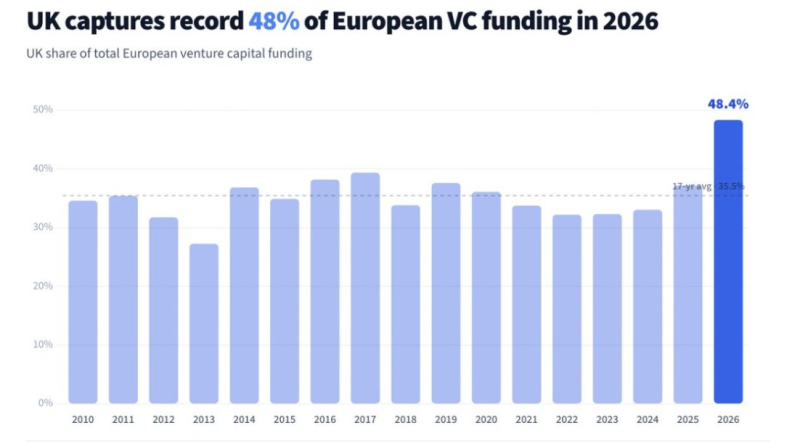
The UK captured nearly half of all European VC funding in 2026, the highest share on record. At first glance, this looks like a success story for London. But the more important question is what it says about the rest of Europe.
Because this chart may reflect something much larger:
- declining European risk appetite;
- capital concentration around AI;
- weakening startup ecosystems outside a few hubs;
- growing fragmentation inside Europe’s innovation economy.
The UK is not simply attracting more venture funding. It is absorbing a larger share of Europe’s future technology infrastructure.
AI is accelerating capital concentration
AI markets naturally reward concentration. Large models require enormous computing infrastructure, deep pools of capital, elite technical talent, dense investor networks, and hyperscale cloud access. That creates gravitational effects.
Capital flows toward ecosystems already capable of scaling quickly. Founders move toward larger funding pools. Talent clusters around existing AI hubs. Investors become increasingly reluctant to finance fragmented or slower-moving ecosystems. The result is a feedback loop.
The strongest ecosystems attract more capital, which attracts more talent, which attracts even more capital. The UK appears to be benefiting from that cycle faster than much of continental Europe.
| Signal | What it means |
| UK captured 48% of European VC funding | Capital is concentrating around one ecosystem |
| Long-term average is ~35.5% | 2026 represents a major break from the norm |
| AI requires larger capital pools | Scale matters more than local startup density |
| Europe remains fragmented | Smaller ecosystems may struggle to compete |
Europe may be developing a two-speed innovation economy
The chart also highlights a growing divergence inside Europe itself. For years, European policymakers discussed building a competitive continent-wide innovation ecosystem. In practice, venture capital is becoming increasingly unevenly distributed.
A larger share of funding is concentrating around:
- London;
- AI-heavy sectors;
- late-stage companies;
- infrastructure-scale startups.
That creates a difficult environment for smaller European ecosystems trying to compete for talent, compute infrastructure, international investors, and growth capital. This becomes especially important in AI because scale matters more than in previous startup cycles.
Earlier generations of European startups could still compete through smaller teams, lower costs, and niche specialization. Modern AI markets increasingly reward compute access, data scale, and financing capacity. That advantages ecosystems capable of concentrating resources quickly.
London is benefiting from being financially native
Part of the UK’s advantage comes from something structural rather than technological. London already operates as one of the world’s largest financial centers. That matters because AI is no longer behaving like a traditional software startup sector. It increasingly resembles a capital-intensive infrastructure race.
Britain sits at the intersection of:
- global finance;
- venture capital;
- institutional investors;
- legal infrastructure;
- international talent.
That combination becomes more valuable as AI shifts from experimental software into foundational economic infrastructure. London is not only attracting startups. It is attracting the financing layer underneath the next generation of technology companies.
The rest of Europe faces a scaling problem
Europe still produces strong universities, technical talent, research labs, and globally respected engineering ecosystems. The issue is scaling. Many European startup ecosystems remain fragmented across regulation, capital markets, investment cultures, stock exchanges, and public policy frameworks.
That fragmentation becomes a competitive disadvantage during periods when industries consolidate rapidly around scale and capital access. AI intensifies that pressure because it compresses time. Companies now need to scale infrastructure, hiring, compute access, and commercialization much faster than previous startup generations. Ecosystems that cannot move quickly enough risk becoming dependent on external platforms and foreign capital.
That may be the deeper meaning behind the chart. The UK’s growing dominance in European venture funding may not simply reflect British strength. It may reflect Europe’s difficulty building integrated capital markets large enough to compete in the AI era.
 Artem Voloskovets