Peter Smith

Europe's approach to citizenship is not converging. If anything, the latest Eurostat data suggests the gap between the bloc's most open systems and its most restrictive ones is staying wide. Sweden is operating in a different category entirely, and the long tail of low-rate countries below it tells a story about how fragmented integration pathways remain across the EU.
EU_Eurostat published the 2024 breakdown, and the distribution it reveals is striking in both directions.
Sweden's 7.5 EU Naturalisation Rate Sits Nearly 3 Times Above the Bloc's 2.7 Average
At the top of the chart, Sweden leads with 7.5 acquisitions of citizenship per 100 resident non-nationals. Italy follows at 4.1, with Spain and the Netherlands both at 3.9. The middle tier includes Belgium and Poland near 3.7, Finland at 3.1, Ireland at 2.9, and Germany at 2.4.
Sweden is not just first, but comfortably ahead of the rest of the field. The EU aggregate stands at 2.7, which means Sweden is nearly three times the bloc-wide average. - EU_Eurostat
That gap matters beyond the ranking itself. A naturalisation rate nearly three times the EU average reflects something structural about how Sweden processes citizenship applications, not just a one-year anomaly. Whether that reflects faster administrative timelines, lower residency requirements, or different political priorities, the outcome is measurably different from what most other member states are producing.
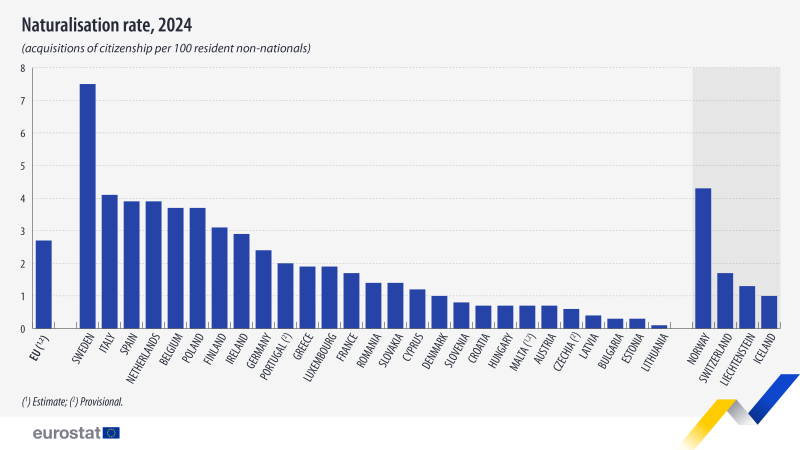
Even outside the EU, the contrast is visible. Norway comes in at 4.3, above most EU members, while Switzerland sits at 1.7, Liechtenstein at 1.3, and Iceland at 1.0.
EU Naturalisation Gap Shows Long Tail From France at 1.7 Down to Lithuania at 0.1
The lower half of the distribution is where the divergence becomes most apparent. France sits at 1.7, Romania and Slovakia at 1.4, Cyprus at 1.2, and Denmark and Iceland at 1.0. Below that, Slovenia, Croatia, Hungary, Malta, and Austria record even lower figures. Lithuania posts the lowest rate in the dataset at around 0.1, with Bulgaria and Estonia near 0.3 and Latvia at 0.4.
That distribution does not suggest convergence. It suggests a bloc split into very different citizenship systems: a small upper tier, a crowded middle, and a long tail where pathways to naturalisation remain comparatively limited.
This isn't a minor statistical spread. The distance between Sweden at 7.5 and Lithuania at 0.1 represents fundamentally different national approaches to how and when long-term residents become citizens. Those differences have real downstream effects on workforce integration, tax base development, and social cohesion over time.
EU asylum applications reached 669,000 in 2025, with Venezuela leading at 13%, which adds context to why naturalisation pipelines and their speed matter at a practical policy level.
EU Naturalisation Data Feeds Into Broader Aging and Labor Integration Pressures
The demographic backdrop makes the naturalisation gap more consequential than it might otherwise appear. The EU's median age has reached 44.5 years, nearly 15 years above the global average, which means the region is increasingly dependent on migrant integration to sustain workforce participation and social systems.
Countries in the long tail of the naturalisation chart aren't just moving slowly on citizenship paperwork. They're potentially delaying the labor market integration that their own aging demographics require. 25.4% of young Europeans already work while studying, with the Netherlands at 74.3% and Romania at just 2.4%, another dimension of how unevenly human capital is being deployed across the bloc.
Sweden's 7.5 rate shows what faster integration looks like in practice. The rest of the distribution shows how far most of the EU remains from replicating it.
 Peter Smith