Saad Ullah
As The Kobeissi Letter noted, University of Michigan consumer sentiment has fallen to 47.6 - the weakest reading in the series - while the S&P 500 sits just 3% below its all-time high. The chart captures that split clearly: Wall Street continues to push upward while Main Street confidence keeps sliding.
A SPY vs Sentiment Gap That Keeps Getting Wider
The visual trend is hard to ignore. The S&P 500 line remains in a long-term upward path, recovering from major setbacks and continuing to press near the top of its range. By contrast, the consumer sentiment line has broken down sharply and now sits at a fresh low.
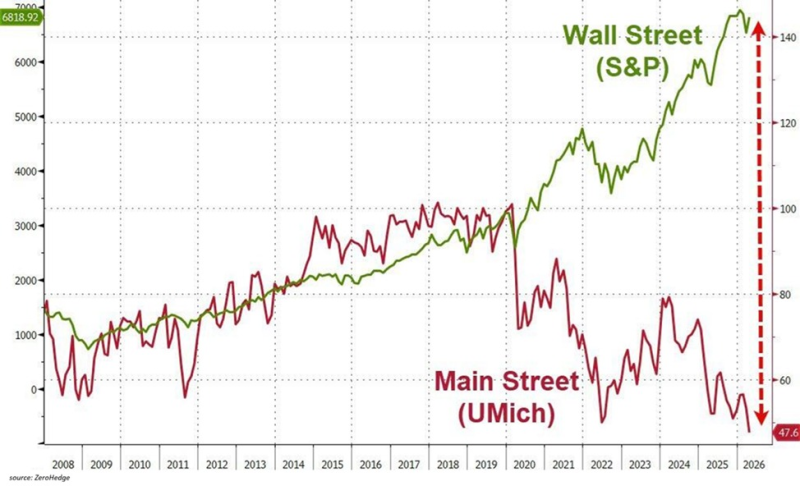
Since the 2020 pandemic, consumer sentiment has dropped by roughly 50% while the S&P 500 has rallied more than 200%. The two lines, which were far closer in earlier years, now show an unusually wide separation that continues to grow rather than converge.
S&P 500: Fear & Greed Index Crashes to 7 as Market Sentiment Hits Multiyear Lows shows how other sentiment measures have been deteriorating alongside the University of Michigan reading - reinforcing that the collapse in consumer confidence is not an isolated data point but part of a broader pattern of weakening sentiment metrics.
Wall Street Holds Up as Main Street Weakens
The tweet ties that split to mounting pressure on households. Inflation, higher housing costs, and a weakening job market are increasingly squeezing consumers - even as equities remain elevated. That helps explain why market strength is not translating into stronger confidence on the ground.
The chart does not suggest that SPY has broken its broader upward structure. Instead, it shows the S&P 500 still holding near peak levels while sentiment deteriorates further - Wall Street reflecting resilient asset prices while Main Street reflects economic strain.
S&P 500 Tests $690 Resistance As Price Consolidates Near Highs captures the technical picture on the equity side, showing how SPY is maintaining its position near highs even as the fundamental backdrop of consumer confidence continues to deteriorate beneath it.
Ownership Explains the SPY and Sentiment Disconnect
The argument sharpens around wealth concentration. According to the tweet, 87% of all equities are held by the wealthiest 10% of households - which means rising stock prices do not benefit everyone equally, even when headline indexes remain strong.
S&P 500 Climbs as Bearish Sentiment Falls to a 7-Year Low adds another dimension to the sentiment picture, showing how investor sentiment and consumer sentiment have been moving in opposite directions - with market participants growing less bearish even as households grow more pessimistic about their own economic situation.
 Saad Ullah