Marina Lyubimova
Kalshi’s latest funding round may represent a turning point for prediction markets.
The company raised $1 billion at a $22 billion valuation in a round led by Coatue, with participation from major financial and technology investors including Morgan Stanley, Sequoia Capital, and Andreessen Horowitz.
But the bigger story is not just the valuation. It is the growing belief that prediction markets could evolve into an entirely new layer of the financial system.
What Kalshi Is Actually Building
Kalshi was founded around a simple idea: turn real-world events into tradable financial markets. Instead of debating probabilities through polls, forecasts, analyst opinions, or social media narratives, users trade contracts tied directly to outcomes.
Examples include:
- election results,
- inflation data,
- Federal Reserve decisions,
- recession probabilities,
- geopolitical developments,
- and AI or technology milestones.
The price of each market effectively becomes a real-time probability signal generated through trading activity.
Kalshi argues this creates a more transparent and dynamic forecasting system than traditional prediction methods.
Prediction Market Volume Is Exploding
The scale of growth is becoming difficult for Wall Street to ignore.
Kalshi says it now controls more than 90% of US prediction market volume and that annualized trading volume has reached $178 billion over the past six months.
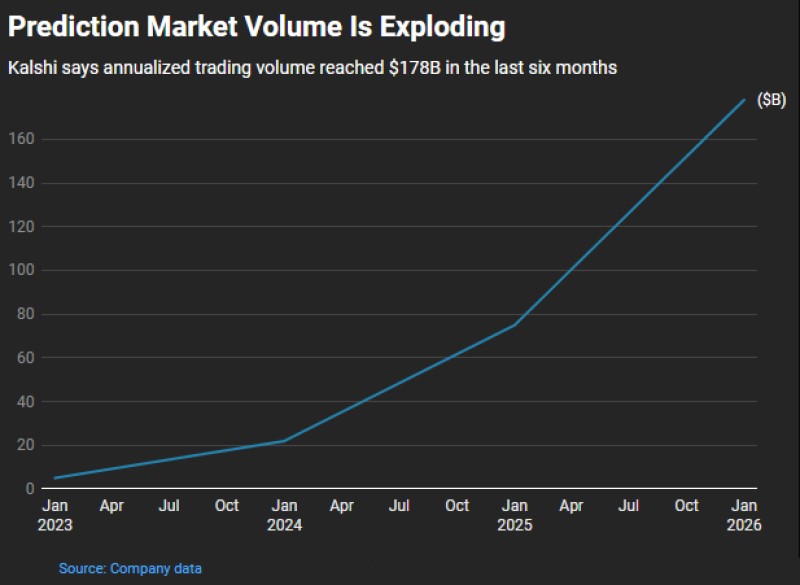
The chart highlights how rapidly prediction markets are scaling. What was once viewed as a niche speculative product is increasingly becoming a high-liquidity financial infrastructure layer attracting institutional capital.
Institutional adoption is also accelerating. Hedge funds, trading firms, and asset managers are increasingly exploring prediction markets as:
- macro hedging tools,
- event-risk pricing mechanisms,
- sentiment indicators,
- and alternative data sources.
That shift matters because financial markets increasingly revolve around probabilities rather than fixed outcomes.
Modern trading systems constantly attempt to price:
- inflation expectations,
- policy changes,
- recession risk,
- political outcomes,
- and geopolitical shocks.
Prediction markets compress those probabilities into directly tradable instruments.
Markets Are Starting to Trade Probability Itself
The rise of prediction markets reflects a broader transformation happening across finance.
Traditional forecasting systems are fragmented:
- economists publish estimates,
- banks issue probability models,
- polls measure sentiment,
- analysts produce targets.
Prediction markets merge all of those signals into one continuously updated price.
That is why some investors increasingly view them less as gambling platforms and more as information markets. The concept becomes especially powerful in a world dominated by AI, algorithmic trading, and real-time data processing. Markets that efficiently aggregate probabilities can become valuable inputs for hedge funds, institutions, and automated trading systems.
Wall Street Is Betting That Prediction Markets Become Financial Infrastructure
The valuation signals that investors are betting on long-term infrastructure, not short-term trading hype. Kalshi is positioning itself as a foundational layer for probabilistic finance - a system where uncertainty itself becomes a tradable asset.
If institutional participation continues growing, prediction markets could eventually expand into:
- portfolio hedging,
- corporate risk management,
- macro forecasting,
- and financial data infrastructure.
The industry still faces regulatory and legal challenges, particularly around how prediction markets are classified and supervised. But the size of Kalshi’s funding round suggests major investors increasingly believe prediction markets are becoming a permanent part of modern financial markets rather than a temporary speculative trend.
 Marina Lyubimova