Eseandre Mordi

Wall Street is telling two very different stories about U.S. equities right now. Small-cap companies grouped in the Russell 2000 are seeing their profit expectations quietly cut, while the S&P 500 and Nasdaq keep getting upgraded. The divide is real, it is growing, and it matters for anyone trying to figure out where earnings momentum actually lives.
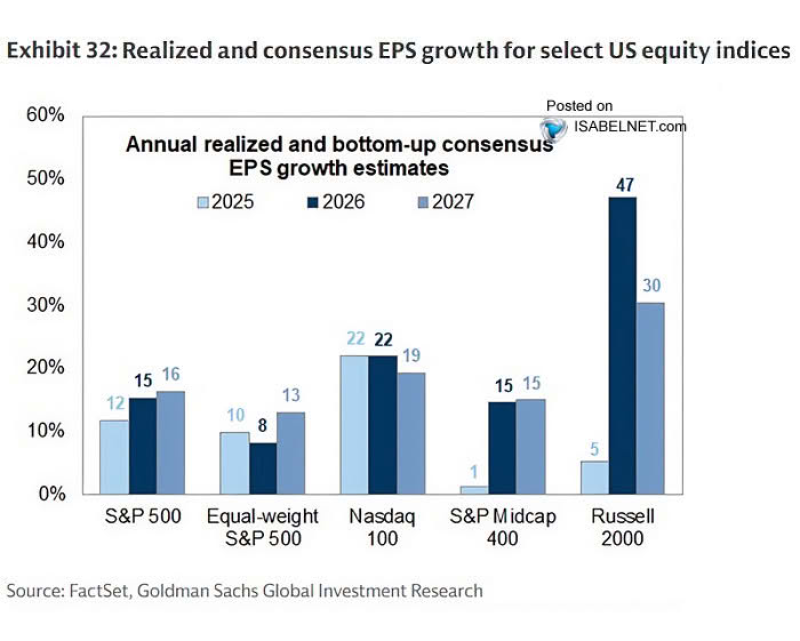
Russell 2000 Earnings Forecast Slashed From 59% to 47% for 2026
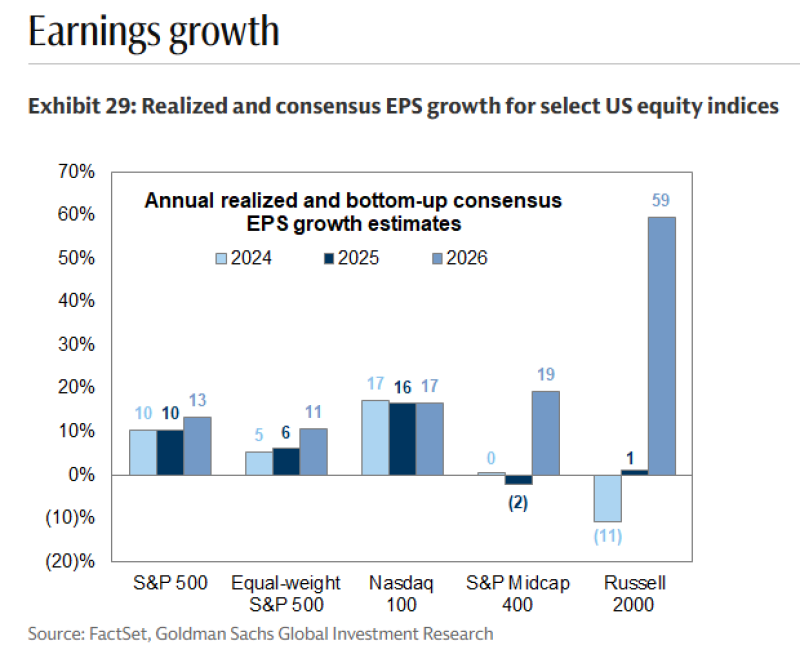
Analysts have been pulling back on their Russell 2000 targets for months. As Lance Roberts flagged, earlier expectations placed RUT earnings growth at roughly 59% for 2026. The latest round of revisions has pushed that number down to around 47%, a drop of more than 12 percentage points. Projections for 2027 have softened as well, now sitting near 30%. Small-cap companies carry more sensitivity to interest rates and tighter credit conditions, and both are still biting.
Wall Street was previously overly optimistic about earnings growth for small- and mid-cap firms heading into 2026.
The numbers reflect a straightforward reality: smaller businesses borrowing at elevated rates face a steeper climb to deliver the earnings growth that analysts were counting on last year. When financing costs stay high and economic momentum stays uneven, the gap between what analysts hoped for and what companies can actually deliver tends to widen fast.
Magnificent Seven Lift S&P 500 and Nasdaq Outlooks Higher
While Russell 2000 forecasts are shrinking, the picture for large-cap indices is moving in the opposite direction. S&P 500 and Nasdaq 100 earnings projections have been revised upward, largely because the biggest technology companies, widely called the Magnificent Seven, keep delivering. TSLA Holds Steady Near $480 as Consolidation Pattern Emerges is one example of how major tech names continue to anchor investor sentiment across broader equity markets.
The contrast between the two halves of the market is increasingly difficult to ignore. Large technology firms are pulling earnings growth upward for the entire S&P 500, while smaller companies face a more uncertain path. Analysis like Tech Stock Battle 2025: Nvidia or Intel for Investment captures just how thoroughly dominant technology companies have become in shaping where earnings growth is actually expected to come from. For investors tracking sector rotation, the message from updated forecasts is clear: size and sector still matter enormously in 2026. Also worth watching is the latest update on AMD Stock Surges on Wedbush's $270 Price Target, which adds further context to the earnings momentum building inside large-cap tech.
 Eseandre Mordi