Eseandre Mordi

Liquidity is building again beneath the surface of the global economy. The latest M2 charts show the United States, China, the euro area, Germany, and the United Kingdom all moving higher - with several already at fresh highs - while Japan remains the clear outlier. As Bull Theory noted, the significance is not just that money supply is growing, but that it is doing so across multiple major economies at the same time.
The Broad M2 Turn Higher Across Major Economies
The chart presents a synchronized move rather than an isolated rebound. China's M2 stands near $49.96 trillion and is rising sharply. The euro area is around $19.4 trillion, the United States near $22.67 trillion, and both Germany and the UK are already pressing into new highs. Japan, by contrast, remains below its earlier peak and is still recovering rather than leading.
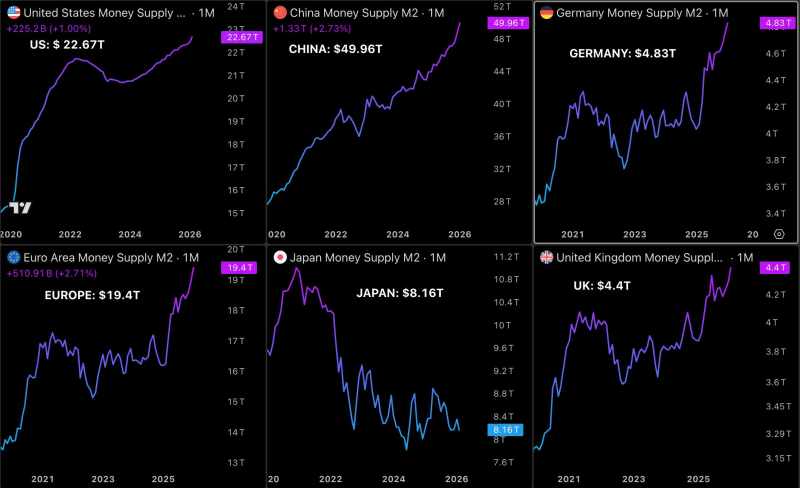
That breadth matters. When liquidity expansion is dispersed across several major economies at once, it tends to carry more weight than a one-country move. The visual message from the chart is straightforward: global monetary conditions are becoming less restrictive in practice, even if policy language has not fully caught up.
When liquidity expansion is dispersed across several major economies at once, it tends to carry more weight than a one-country move.
U.S. M2 Money Supply Reaches Record $22.3 Trillion in October 2025 captured the earlier milestone in U.S. money supply growth, providing context for how the current reading fits into the broader expansion trend.
The Divergence Between Central Bank Messaging and Global M2 Data
One of the clearest takeaways from the chart is the mismatch between official rhetoric and actual liquidity data. Central banks may still frame policy as tight, but broad money is rising again across most of the developed world and China.
The chart does not argue for an immediate one-way move in asset prices, but it does show that the underlying liquidity backdrop is no longer contracting. That is a meaningful shift from the tightening phase that dominated 2022 and parts of 2023.
The pressure created by shrinking liquidity is easing - and the environment is becoming more supportive for risk-taking, even if policy language has not fully caught up.
In market terms, it suggests that conditions are becoming more supportive for risk-taking - regardless of what central banks say at their next press conference.
Why China's $50 Trillion M2 Stands Out in This Global Cycle
Among all the panels, China may be the most important. Its M2 base is by far the largest on the chart, and the latest reading shows continued acceleration toward $50 trillion. When liquidity grows at that scale, it matters well beyond domestic assets - influencing commodity flows, emerging-market conditions, and broader investor appetite globally.
China M2 Growth at 9% in February 2026 Signals Weak Inflation Trend adds nuance to that expansion, showing how the pace of Chinese money supply growth is translating - or not translating - into domestic price pressure.
A sustained expansion in China, combined with rising money supply in the U.S. and Europe, can materially loosen global financial conditions. The chart supports exactly that reading right now.
The Setup Global M2 Markets Have Seen Before
The post-2020 period was marked by rapid liquidity growth and strong performance across a wide set of assets. Later, when M2 growth slowed or reversed, markets faced a much tougher repricing environment. What is visible now is another directional shift.
The current move is not uniform in size and Japan is still lagging, but the aggregate picture has clearly turned up - and if that trend continues, liquidity will remain an important force in how markets behave.
Bitcoin Price Lags Behind Global Liquidity Growth explores one concrete example of how this liquidity backdrop is - or isn't - showing up in asset prices yet, raising the question of whether markets are simply behind the curve on what the M2 data is already signaling.
For now, the chart's main message is not about a single asset or a single country. Global money supply is rising again - and that kind of synchronized expansion has historically mattered far more than the headlines surrounding it.
 Eseandre Mordi