Usman Salis
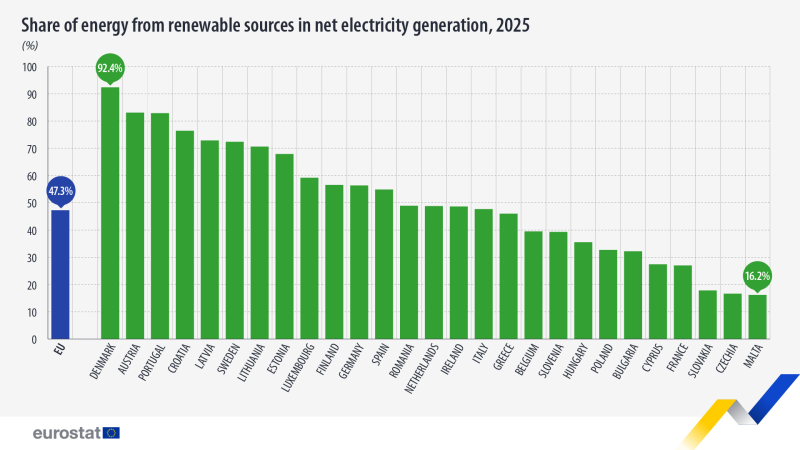
⬤ Fresh data from Eurostat paints a striking picture of where Europe actually stands on clean electricity. Denmark sits at the top with 92.4% of its power coming from renewables in 2025, with Austria at 83.1% and Portugal at 82.9% close behind. The EU-wide average lands at 47.3% - meaning roughly half the bloc's electricity now runs on clean sources.
⬤ Each leading country gets there differently. Denmark runs almost entirely on wind, while Austria and Portugal lean on hydroelectric capacity backed by growing wind infrastructure. This fits neatly into the wider European push toward low-carbon grids, visible in efforts like France's clean power expansion strategy, which aims to add 20% more clean generation by 2030.
The EU average stands at 47.3% - nearly half of electricity generation across the bloc now comes from renewables.
⬤ The bottom of the list tells a different story. Malta records just 16.2%, the lowest in the EU, with Czechia at 16.6% and Slovakia at 17.8% not far ahead. These figures reflect genuine structural barriers - limited natural resources, aging infrastructure, and slower regulatory momentum. Patterns like these show up frequently when analyzing renewable energy adoption in European power markets, where geography and legacy systems still shape outcomes more than policy ambition alone.
⬤ The overall picture is one of real but uneven progress. The EU is moving, but the gaps between member states remain wide. That uneven pace connects to larger questions about long-term systemic change, themes that come up in discussions of sustainable energy use and long-term transition models - where short-term results rarely reflect the full trajectory of reform.
 Usman Salis