Peter Smith

The U.S. Dollar Index came under pressure last week after the latest nonfarm payroll report came in below expectations, cooling bullish sentiment and prompting short-term profit taking across currency markets. The session ended with a bearish upper-wick candle, a pattern that signals buyers pushed the DXY price higher intraday but were rejected near the highs as sellers stepped in. It was a clear reminder that momentum alone does not break key technical levels.
DXY Fails to Break the 200 EMA and 100 Resistance Zone
On the daily chart, the Dollar Index attempted to push above the 200 EMA but could not hold that ground, which weakened the short-term bullish case. The rejection landed right at the psychologically important 100 resistance zone, a level that has repeatedly capped rallies over recent months. Each time price tests this area and retreats, it reinforces the ceiling and raises the stakes for the next attempt.
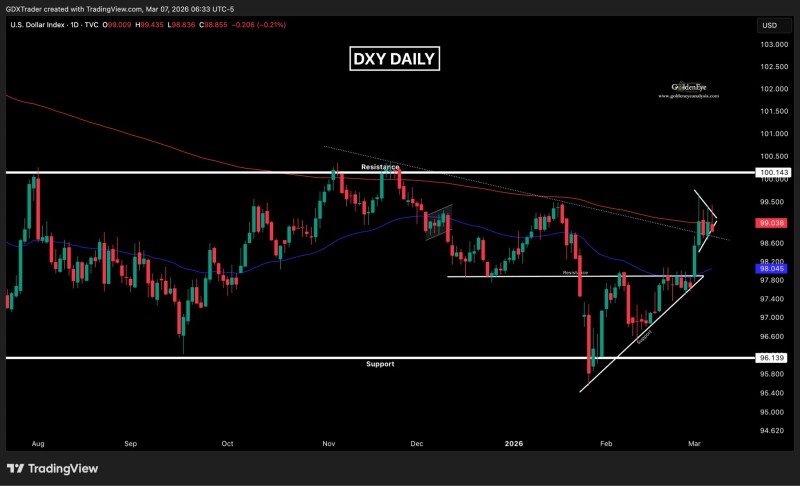
From a structural standpoint, DXY continues to trade inside a broad consolidation range between roughly 96 and 100. The chart shows a tightening structure that resembles a pennant formation, with price compressing between rising support and descending resistance. The 98-100 region has historically acted as a key technical inflection zone, where repeated tests tend to precede stronger directional moves once macro conditions shift.
Range-Bound Dollar Awaits the Next Macro Catalyst
The ongoing range-bound behavior reflects broader macro uncertainty as markets digest mixed economic data and reassess Federal Reserve policy expectations. Until the Dollar Index decisively breaks above 100 or falls through long-standing support near 96, the dollar is likely to stay rangebound. Traders watching the DXY 10-year rally pattern are waiting to see whether the current compression resolves to the upside or breaks down under the weight of softening labor data and shifting rate expectations.
For now, the path of least resistance remains sideways. A sustained close above 100 would change the near-term outlook, while a breakdown below 96 support would open the door to a more significant correction. Either way, the next macro catalyst, whether that is another labor report, a Fed statement, or a shift in inflation data, will likely be the trigger that forces a resolution.
 Peter Smith