Peter Smith
A notable liquidity event is unfolding in the bond market. As Mark noted, the U.S. Treasury has announced a $15 billion buyback of its own debt - matching a previous record. Combined with ongoing Federal Reserve bill purchases this month, the move highlights a growing wave of liquidity entering the system at a time when markets are highly sensitive to capital flows.
The Operation That Releases Treasury Liquidity
The Treasury announcement confirms a buyback targeting up to $15 billion in securities, with maturities ranging from May 2026 to April 2028. The operation is scheduled for April 16, with settlement on April 17.
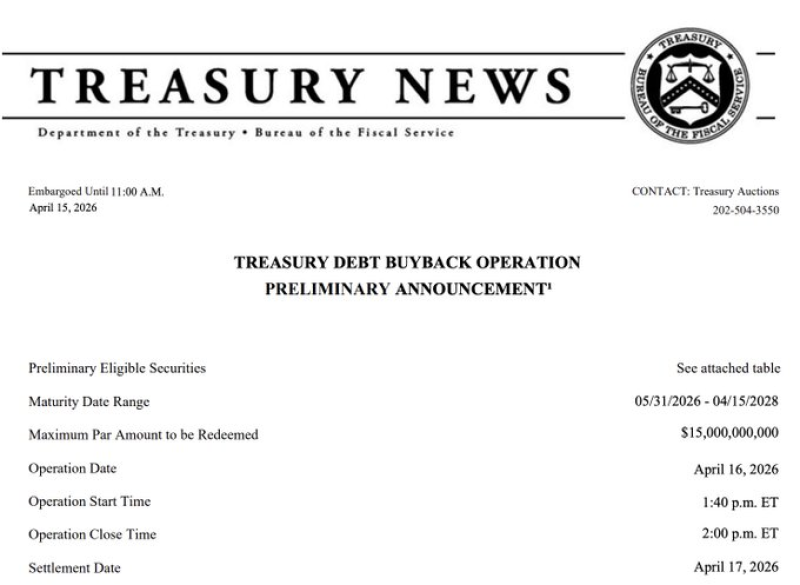
This structure matters because it directly returns cash to bondholders. When Treasuries are repurchased, investors holding those securities receive liquidity that must be redeployed. Unlike passive market moves, this is a defined and immediate injection tied to a scheduled operation.
Record $15B Treasury Buyback: Largest Debt Repurchase Operation Confirmed provides the fuller operational context for why this size represents a meaningful rather than routine intervention - showing how the scale compares to prior buyback operations and what past executions at this level have meant for near-term liquidity conditions.
Why This Treasury Buyback Scale Matters Now
At $15 billion, this matches the largest operations previously conducted - signaling that this is not a routine adjustment but a meaningful liquidity event. The tweet also points to an additional $40.5 billion in Federal Reserve bill purchases this month. While separate in mechanism, both flows contribute to the same outcome: more cash circulating through the financial system.
Together, they create a short-term environment where liquidity conditions are expanding, even without any changes in interest rate policy. The operational details define the setup precisely:
- A fixed maximum buyback size of $15 billion
- A short-dated maturity window for eligible securities
- A tightly scheduled execution and settlement timeline on April 16-17
Where Treasury Buyback Capital May Move Next
The key question is not whether liquidity is being added - it is where it goes. When bondholders receive cash from buybacks, that capital is typically reallocated. Depending on market conditions, it can flow into equities, crypto, or other risk assets.
U.S. Treasury Debt Buyback Sparks Market Optimism - XRP in Focus shows how prior buyback operations have been interpreted through the lens of crypto market positioning - reinforcing that the reallocation question is not hypothetical but has produced measurable effects in digital asset markets during previous liquidity injections.
10Y Treasury Yield Breaks Above 4.3% as Oil-Linked Currency Metrics Surge adds the rates backdrop that makes the timing of this buyback significant - a liquidity injection arriving at a moment when yields are already under upward pressure creates a counterbalancing force that could influence how quickly the redeployed capital moves into risk assets.
 Peter Smith