Usman Salis

China has officially released its macroeconomic targets for 2026, setting a GDP growth range of 4.5% to 5% alongside a goal of creating more than 12 million new urban jobs. Policymakers also aim to keep inflation near 2% and ensure that household income growth stays broadly aligned with overall economic expansion — signaling a continued focus on stable, balanced development.
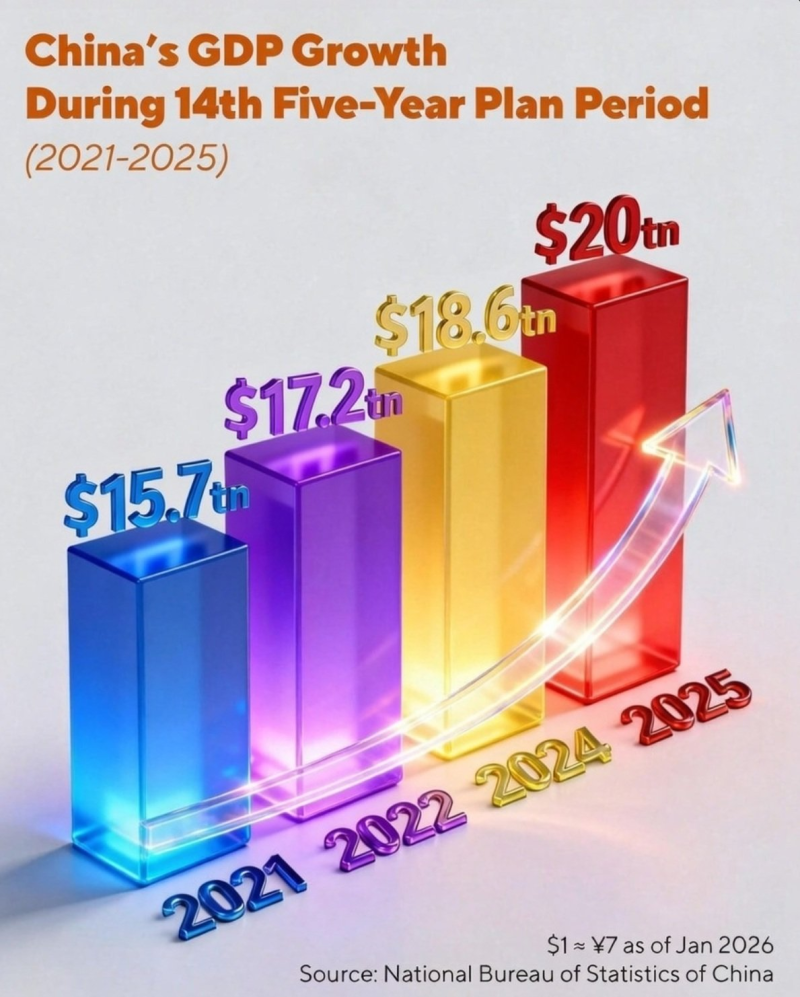
China's GDP trajectory over the 14th Five-Year Plan period (2021-2025) tells a story of steady growth: from $15.7 trillion in 2021 to $17.2 trillion in 2022, climbing to $18.6 trillion in 2024 and reaching approximately $20 trillion by 2025. Data from the National Bureau of Statistics confirms a consistent upward curve in total economic output, even as annual percentage growth rates have gradually moderated.
At the current scale, China could add roughly $1 trillion to its economy within a single year — a figure that illustrates the sheer size of its expanding economic base. Even a moderate growth rate at this level produces an outsized absolute gain, underscoring how the country's economic mass reshapes the math of global GDP comparisons.
With GDP crossing the $20 trillion threshold, China's incremental gains carry growing weight for global trade flows, commodity demand, and financial market sentiment. Major policy shifts in large economies routinely ripple across international markets — much like how macroeconomic signals influence equity valuations and liquidity conditions worldwide. The 2026 framework reinforces that China's growth path remains a key variable in the global economic equation.
 Usman Salis