Marina Lyubimova

USD/JPY is taking a breather near the 158.50 level, but don't mistake that pause for weakness. The pair's broader technical structure remains firmly bullish, with the price continuing to post consistent higher highs and higher lows along a clearly defined rising trendline. According to recent coverage of USD/JPY's surge past 150.00, rallies in this pair are typically powered by a combination of U.S. yield strength and shifting risk sentiment, and the current move fits that same playbook.
After topping out around 158.90, the pair has pulled back into a consolidation range between 158.40 and 158.50. This kind of sideways price action after a strong directional push is a normal part of the market cycle, often setting the stage for the next leg higher rather than signaling a reversal.
Key Support and Resistance Levels to Watch Around 158
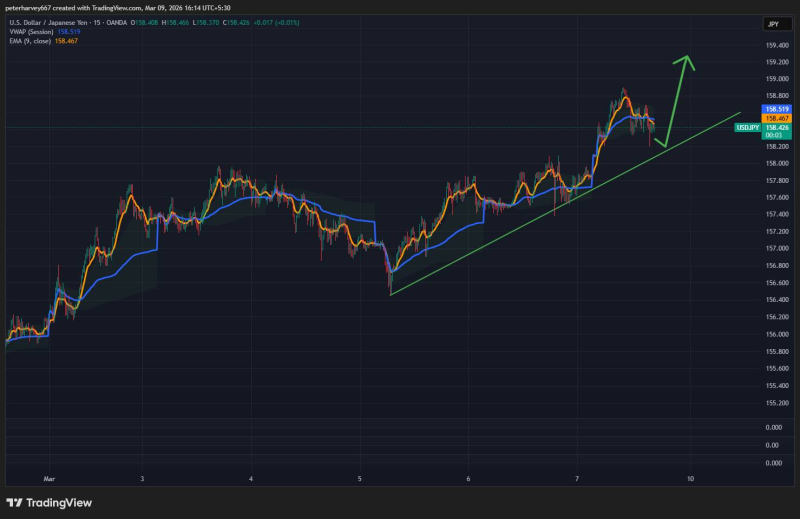
The technical picture gives traders a clean framework to work with. On the downside, support levels are stacked at 158.20, 158.00, and 157.60. A rising trendline active since early March is underpinning the current price structure, with an EMA and VWAP cluster in the 158.20 to 158.40 zone acting as dynamic support.
Price remaining above key EMAs and VWAP suggests the bullish trend structure remains intact, even as short-term momentum cools.
As long as price holds above 158.00, the bullish case stays intact. As analysts have noted, rate-hike pushback from the Bank of Japan continues to suppress yen demand, adding a fundamental tailwind to the technical setup.
Bullish Continuation Still on the Table Above 158.00
On the resistance side, the chart highlights levels at 158.90, 159.20, and 159.40. A sustained hold above 158.00 would open the door for a push toward the 159 region. However, a breakdown below 157.60 would shift the short-term picture and could indicate a deeper corrective phase. Previous analysis of USD/JPY's channel structure has shown how quickly sentiment can shift when key trendlines give way, making the 158.00 level particularly important for bulls to defend over the coming sessions.
For now, the weight of the evidence favors the bulls. USD/JPY remains one of the most actively traded currency pairs globally, with U.S. dollar dominance and Japan's yield dynamics keeping the broader trend skewed to the upside.
 Marina Lyubimova