Alex Dudov

⬤ EUR/USD is expected to trend higher toward the 1.22 level in 2026 as the US dollar faces pressure from economic and political risks. The bank holds a bearish outlook on the dollar, citing stretched equity valuations and fiscal and political uncertainties ahead of the US midterm elections. ING's baseline forecast shows the euro gaining ground against the dollar within a volatility cone that incorporates implied market risk and potential future price paths.
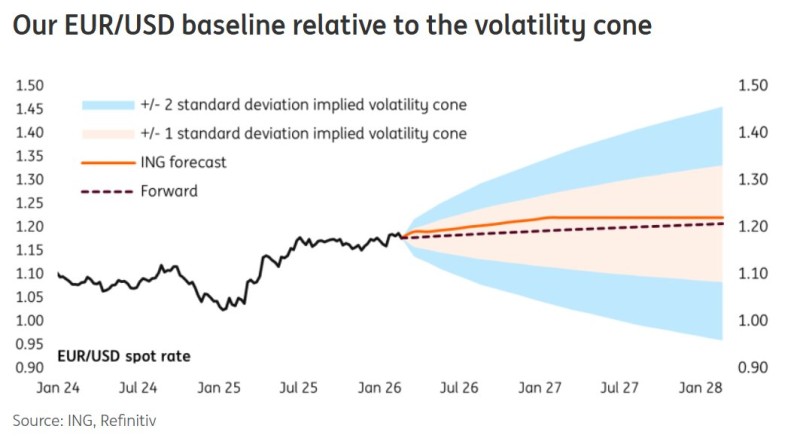
⬤ The accompanying chart titled "Our EUR/USD baseline relative to the volatility cone" illustrates the spot rate stabilizing around the mid-1.10s in early 2026 before gradually climbing toward 1.22 by late 2026. The black price line sits near the baseline forecast, while the colored bands represent the plus or minus one and two standard deviation ranges from current implied volatility. This framework suggests that ING's forecast is anchored within plausible market scenarios, with the one standard deviation band stretching approximately from 1.10 to 1.30 and the two standard deviation range extending further.
⬤ ING's downside view on the dollar is rooted in multiple risk factors, including equity market vulnerabilities and looming fiscal and political challenges. In this context, a more moderate dollar translates into a stronger euro, with the 1.22 level serving as a midpoint of the forecast distribution. Unlike a dramatic breakout, the cone shows a broad set of possible outcomes, but the baseline aligns with stable gains.
⬤ The significance of this outlook lies in its implications for broader currency markets and economic sentiment. A weaker US dollar and a rising EUR/USD may influence global trade flows, capital allocation, and risk appetite across major asset classes. As fiscal and political risks unfold through 2026, shifts in the dollar's trajectory could extend beyond forex markets, contributing to broader realignment in cross-border pricing and macroeconomic expectations.
 Alex Dudov