Eseandre Mordi

The price of getting into XRP's elite holder ranks just got a lot cheaper. According to The Crypto Basic, the capital required to crack the XRP "rich list" has dropped from around $6,000 in Q4 2025 to roughly $3,000 following a broader crypto selloff that wiped $1.45 trillion from the digital-asset market over six months. What's interesting, though, is that participation hasn't shrunk along with prices - it's actually been growing.
Cheaper Entry, Same Competitive Ladder
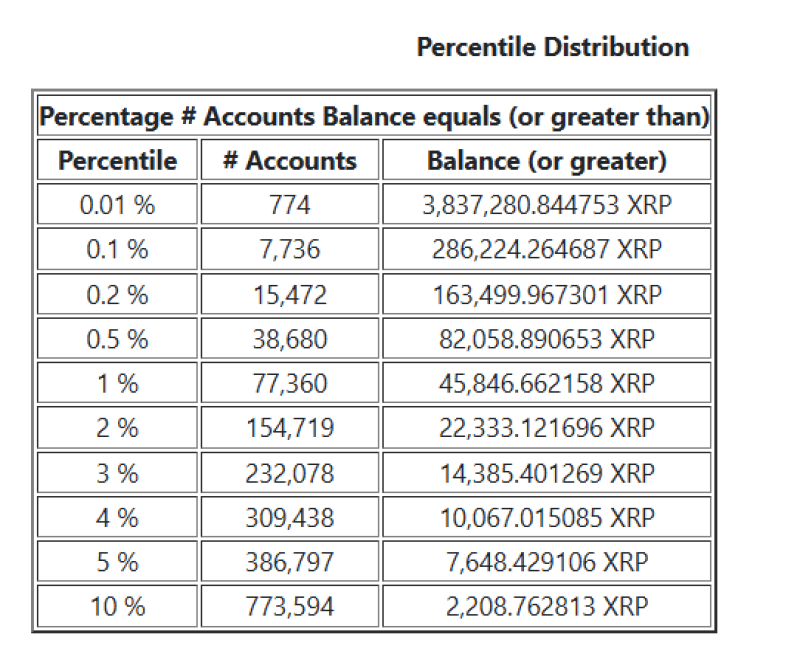
The percentile data tells a pretty clear story. Right now, you need 2,208.76 XRP to sit in the top 10% of all XRP addresses - a cohort that has grown to 773,594 wallets. Climb higher and the numbers get steep fast: 7,648.43 XRP gets you into the top 5%, while the top 1% requires 45,846.66 XRP. Want to crack the top 0.1%? That's 286,224.26 XRP. And the top 0.01% starts at a lofty 3,837,280.84 XRP.
Falling prices have lowered the dollar cost of reaching more exclusive tiers, even though the token thresholds themselves remain steep.
The key distinction here isn't about trading patterns or candlestick charts. This is a snapshot of how a market correction reshapes access. Ownership at the upper end is still heavily concentrated - that hasn't changed. But the path into visible tiers of the distribution has become meaningfully more accessible for smaller buyers.
Wallet Growth Tells a Different Story
Here's where things get more interesting. Lower prices usually come with shrinking participation - that's just how bear markets typically work. XRP appears to be bucking that trend. The top 10% cohort grew to 773,594 addresses even as prices slid, suggesting the market has been broadening underneath the surface rather than simply thinning out.
XRP's decline has reduced the dollar barrier for smaller investors to accumulate enough tokens to move into higher holder brackets.
This is a pattern that tends to show up during prolonged corrections. Momentum traders exit, and slower accumulation begins from buyers willing to build positions at lower levels. The net result is a wider holder base at a lower price - which is exactly what the data appears to show.
Meanwhile, XRP Whales Dump $528M in 48 Hours as Holdings Drop From 5.4B to 5.16B adds another layer to this picture. Large holders have been reducing exposure at the same time smaller wallets are accumulating - a classic redistribution dynamic.
A Redistribution Phase, Not a Collapse in Interest
A falling asset with stagnant or declining wallet growth is usually a bad sign - it signals fading relevance. XRP's situation looks different. The asset has gotten cheaper, but the holder base keeps widening. That combination doesn't guarantee a price reversal, but it does say something about the underlying engagement.
The rich list has not become easy to enter, but it has become notably less expensive - and that alone changes the psychology of the market.
As XRP Price Analysis: Ripple Range Tightens After 7 Weeks, Volatility Incoming covered recently, the broader trading backdrop has been defined by compression and support tests. Add to that the warning signs flagged in XRP Slips Under Long-Term Support as 200-Week SMA Flashes Warning, and it becomes clear that XRP is navigating a tricky stretch. But the holder distribution data suggests that for a certain type of investor, this decline looks less like a reason to exit and more like a window to accumulate.
 Eseandre Mordi