Saad Ullah

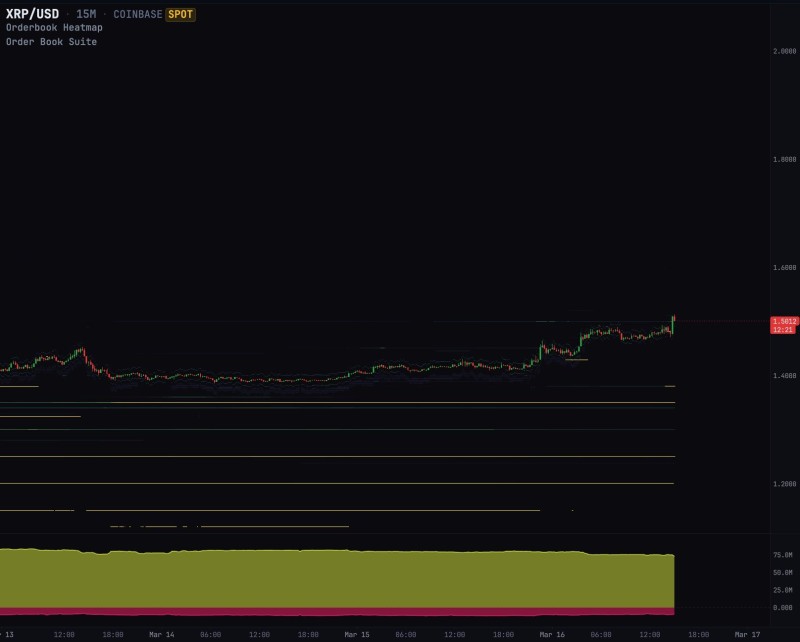
XRP is showing a notable structural edge in the current market. Orderbook data from Coinbase reveals a sharp imbalance between buyers and sellers near the $1.50 level, with buy-side depth significantly outweighing sell-side liquidity. This setup suggests that any upward price movement could encounter far less friction than a move to the downside - making the $2.25 zone a more accessible target than many traders might expect.
9:1 Bid-to-Ask Ratio Builds a Solid Floor Below $1.50
The most striking figure from the current orderbook is a 9:1 bid-to-ask ratio within a 50% price range around $1.50 - one of the strongest buy-side skews observed in recent months. Below the current price, layered buy walls are stacked between $1.40 and $1.20, forming a dense support structure. These liquidity clusters act as shock absorbers, where buyers can absorb selling pressure during short-term pullbacks. Similar dynamics were already flagged earlier this cycle in XRP Liquidity Pool Near $2.25 Sparks Market Debate, which noted how concentrated demand zones tend to hold during volatility.
Thin Sell Liquidity Above $1.50 Opens the Path Toward $2.25
On the upside, the orderbook reveals notably thin sell-side liquidity between $1.50 and $2.00. Fewer sell orders in that range means less resistance for price to clear - and historically, XRP has shown a tendency to move toward dense liquidity zones once the path clears. XRP Faces Massive Liquidity Wall at $2.25 previously detailed why that price level consistently attracts attention, and the current setup reinforces that view. The $2.25 zone functions as a price magnet - thin supply above and stacked demand below create the conditions for a directional move.
That said, orderbook structures shift quickly. The $1.50 zone remains the key level to watch: as long as bid depth holds there, the asymmetric setup favors the bulls. But if buy walls erode or large sell orders appear above, the picture could rebalance fast. XRP Liquidity Pool at $2.25 Sparks Market Speculation explored similar scenarios and why liquidity concentration near $2.25 continues to generate strong market debate. For now, the data points in one clear direction.
 Saad Ullah