Eseandre Mordi

Crude oil is making a move that historically has not ended well for the economy. WTI has climbed from roughly $70 to nearly $120 per barrel in a short window, one of the fastest accelerations in recent memory, and it is happening just as recession probability in the United States is closing in on the 50% mark. That combination is hard to ignore.
80 Years of Oil Shocks: A Pattern Before Every Recession
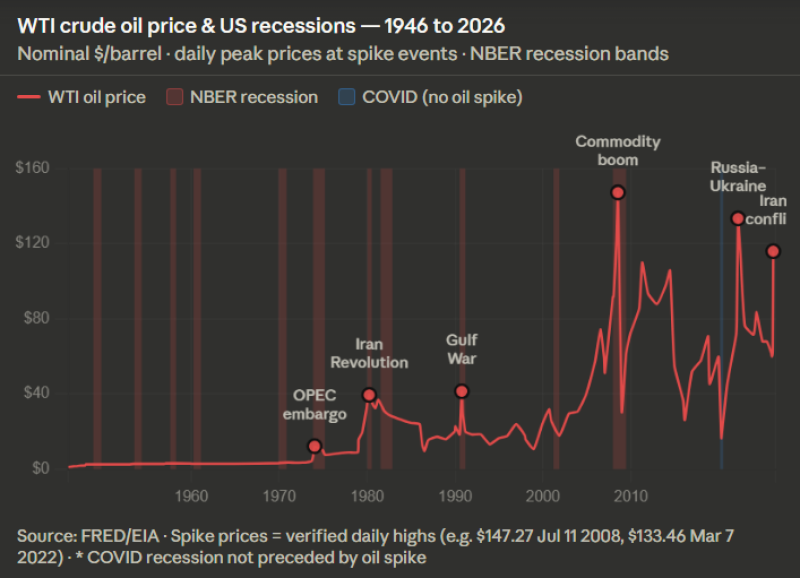
The long-term chart of WTI prices versus US recession periods tells a consistent story going back to 1946. Nearly every economic downturn, marked by shaded bands, was preceded by a meaningful oil price surge. The OPEC embargo, the Iran conflict, the Gulf War, the 2008 commodity boom - each lined up with a sharp move in crude followed by an economic contraction. The one clear exception is COVID-19, where the shock came with no oil spike at all.
$120 Oil and the Macro Stress Threshold
Recession odds have risen roughly 15 percentage points over the past six months, and the current Fed rate environment, oil shock dynamics, and FX volatility are compressing conditions further. At $120, WTI is entering territory historically associated with economic stress. Previous peaks near $147 in 2008 and above $130 in 2022 both arrived close to major turning points in the cycle.
The current move is being driven in part by geopolitical supply disruption. As covered in depth in WTI Crude Oil Spikes to $110-$120 as Strait of Hormuz Closes, the closure of one of the world's most critical shipping lanes can rapidly amplify price action. Supply shocks of this kind have a way of moving faster than central banks can respond.
The broader picture connects energy prices directly to inflation and consumer spending. When oil climbs quickly, it acts as a tax on economic activity - tightening conditions at exactly the wrong moment. Brent topping $100 as Hormuz closure threatens 20% of global supply adds another dimension to this picture, pointing to a supply environment that remains fragile. With recession probability nearing a coin-flip, the energy market may be delivering an early warning that history suggests deserves attention.
 Eseandre Mordi