Saad Ullah

WTI crude oil saw extreme volatility as prices sharply reversed following a massive earlier surge. As The Kobeissi Letter tracked in real time, US oil climbed as much as 30% during the session before pulling back hard. The chart showed WTI trading near $102.98, still up around 12.84% on the day, but well off the intraday high that had pushed prices toward $118 per barrel.
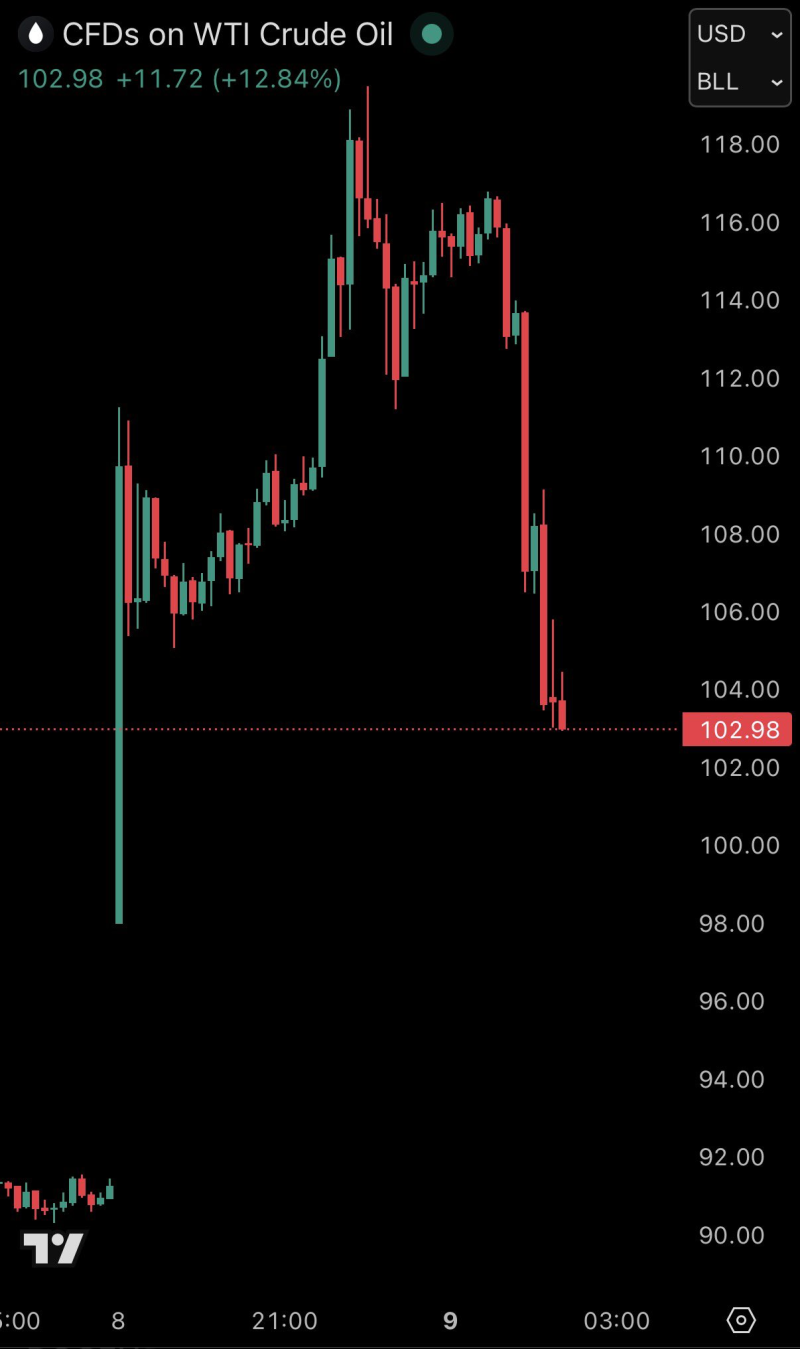
Around 10:30 PM ET, prices were up roughly 30% on the day, briefly touching the $118 range before sentiment flipped. The trigger was a Financial Times report indicating that G7 countries were considering a coordinated release of approximately 400 million barrels from strategic petroleum reserves — a move that would meaningfully boost global supply. Oil markets had already been under pressure heading into the session, making the reversal even sharper once the headline hit.
Strategic reserve releases have historically been used to stabilize prices during periods of market stress or supply disruption.
Within less than four hours of the G7 report, WTI erased more than half of its daily gains. The chart captured a sequence of strong bearish candles as prices dropped from the mid-$110s to just above $102. Despite the selloff, oil finished well in positive territory for the day, which itself underscores just how intense the swing was. WTI has been testing multi-decade trendlines in recent weeks, and this reversal adds another layer of complexity to the broader energy rebound narrative.
The speed of this reversal highlights how sensitive crude oil remains to policy signals and supply expectations. A potential coordinated G7 action introduces near-term uncertainty, leaving traders to reassess whether the earlier surge can hold or if more volatility is ahead. Oil prices remain tightly linked to geopolitical developments and global supply dynamics, and sharp sentiment shifts like this one have become a recurring feature of commodity markets.
 Saad Ullah