Victoria Bazir
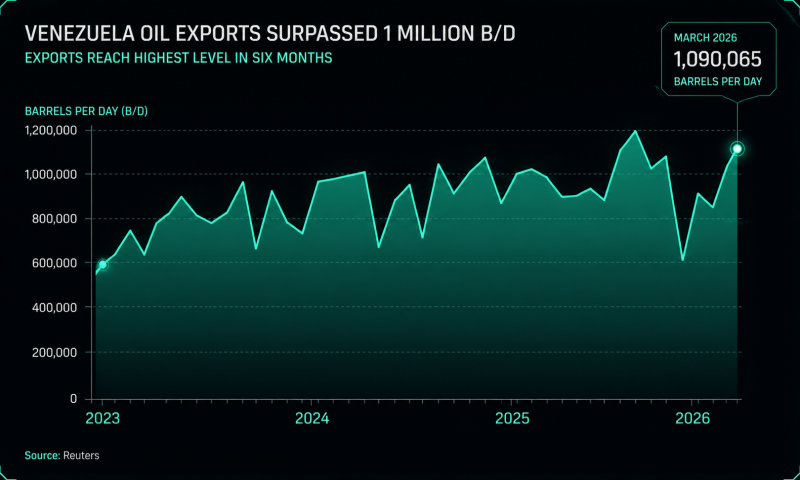
According to Reuters data, exports reached around 1.09 million b/d in March 2026, the first time in six months the country crossed the 1 million threshold. This rebound has been driven by increased shipments to key markets such as India and the Caribbean, alongside renewed activity from global trading firms and oil majors.
The recovery follows major political and regulatory changes after the removal of former President Nicolás Maduro. A new agreement between Caracas and Washington led to partial sanctions relief and opened the sector to foreign participation, enabling companies like Chevron and trading houses such as Vitol and Trafigura to expand operations.
Production has also improved, reaching approximately 1.1 million b/d, up from below 1 million earlier in 2025. While still far from the 3 million b/d levels seen in the 1990s, the recent gains suggest the beginning of a structural recovery in one of the world’s largest oil-producing nations.
What’s driving the rebound
Several factors are fueling the surge in exports:
- Sanctions relief and policy shift The easing of U.S. restrictions allowed Venezuelan crude to re-enter global markets under new oversight frameworks.
- Rising demand from Asia and global traders India has emerged as a key buyer, while trading firms are redistributing cargoes via Caribbean storage hubs.
- Infrastructure reactivation Idle rigs and export terminals are being brought back online as contracts are restructured and investment returns.
- Foreign investment and joint ventures New policies allow private capital into the sector, accelerating output and export capacity expansion.
A new oil player is back on the global stage
Venezuela holds the world’s largest proven oil reserves, and even modest increases in output can impact global supply dynamics. Historically, the country exported over 800,000 b/d to the U.S. alone, highlighting its strategic importance in energy markets.
The return to 1 million+ b/d exports signals that Venezuela could once again become a meaningful supplier, especially as geopolitical tensions and supply disruptions continue to affect oil prices worldwide. Increased Venezuelan output may help ease global supply constraints, particularly in heavy crude markets.
Outlook
Despite the recent recovery, challenges remain. Venezuela’s oil infrastructure is still heavily degraded after years of underinvestment, and scaling production toward 2–3 million b/d will require sustained capital inflows and political stability.
Still, the latest data suggests that the post-Maduro transition is already reshaping the country’s oil sector. If reforms continue and investment accelerates, Venezuela could re-emerge as a key player in global energy markets over the coming years.
 Victoria Bazir