
 Marina Lyubimova

According to recent disclosures, AWS plans to deploy more than one million Nvidia Blackwell and Rubin GPUs during 2026. At roughly 75 accelerators per rack, that equates to nearly 13,900 new server racks and an estimated $30–40 billion worth of Nvidia hardware entering AWS data centers.
AWS AI Buildout in 2026
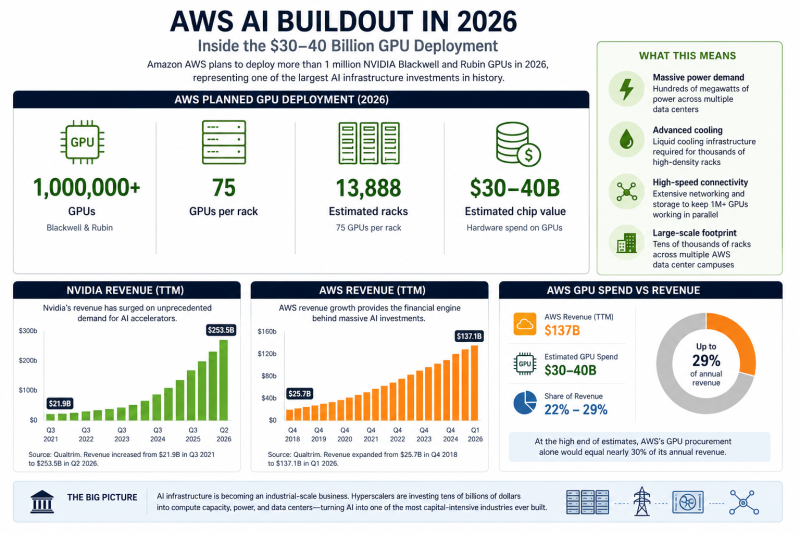
AWS plans to deploy more than 1 million Blackwell and Rubin GPUs, equivalent to roughly 13,888 server racks and $30–40 billion in accelerator hardware.
A deployment of that scale is not merely a hardware purchase. Nearly 14,000 racks would need to be installed, powered, cooled, and connected across multiple facilities. The GPUs themselves are only part of the investment. Networking equipment, storage systems, liquid-cooling infrastructure, and power distribution all add to the total cost of bringing a cluster of this size online.
The figure is striking on its own. Yet its significance becomes clearer when placed alongside the financial trajectories of both companies involved.
Why This Matters for Nvidia
Nvidia's trailing twelve-month revenue has exploded from roughly $45 billion at the end of 2023 to more than $253 billion by mid-2026, according to Qualtrim data. The scale of AWS's planned deployment means a single customer could be responsible for infrastructure purchases equivalent to roughly 12–16% of Nvidia's current annual revenue base.
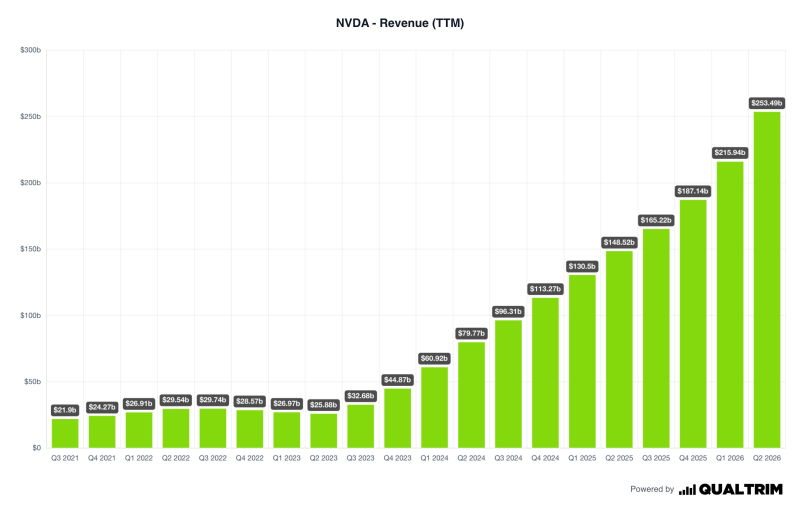
Qualtrim. Nvidia revenue climbed from approximately $44.9 billion in Q4 2023 to $253.5 billion in Q2 2026.
Just a few years ago, a $40 billion order would have represented nearly an entire year of Nvidia sales. Today, it reflects how rapidly AI infrastructure spending has expanded across hyperscalers.
The inclusion of both Blackwell and Rubin hardware is equally notable. Blackwell represents Nvidia's current flagship AI architecture, while Rubin belongs to the company's next-generation roadmap. By planning deployments across both generations, AWS appears to be preparing for sustained demand rather than a short-term capacity buildout tied to a single product cycle.
Why AWS Can Afford It
The other side of the equation is AWS itself. The cloud platform generated approximately $137 billion in trailing twelve-month revenue in early 2026, up from just $26 billion in 2018. That growth has transformed AWS from a profitable cloud business into a financing engine capable of supporting hyperscale AI investments.
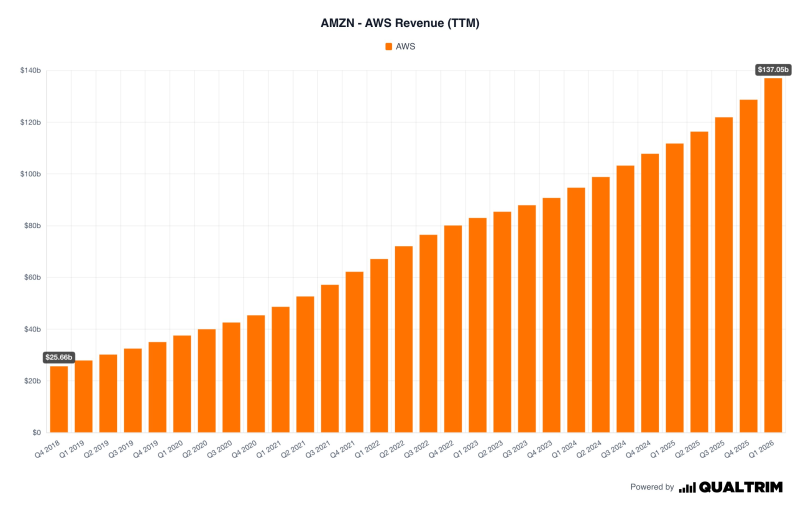
Qualtrim. AWS revenue expanded from approximately $25.7 billion in Q4 2018 to $137.1 billion in Q1 2026.
At the upper end of estimates, the planned GPU purchase alone would equal almost 30% of AWS's annual revenue. Such levels of capital allocation are more commonly associated with infrastructure, energy, or manufacturing projects than with software businesses.
The implication extends beyond Nvidia and Amazon. Training and serving frontier AI models increasingly depends on assets that look more industrial than digital: power infrastructure, cooling systems, networking equipment, and data-center real estate.
Perhaps the most important takeaway is that AI spending is becoming increasingly concentrated among a small number of hyperscalers. Building frontier-scale infrastructure now requires commitments measured in tens of billions of dollars, creating barriers that few companies can realistically match.
 Marina Lyubimova



