Victoria Bazir
The biggest beneficiaries, however, may not be the companies designing AI models or even the firms building accelerators. Increasingly, the winners are the manufacturers supplying the memory that modern AI systems cannot function without.
Samsung Electronics has reached an agreement with its semiconductor labor union that will distribute up to 40 trillion won ($26.6 billion) in bonuses over the next decade, avoiding a potential strike after last-minute negotiations. Under the new profit-sharing structure, average payouts are estimated at between $340,000 and $400,000 per employee.
The AI boom is no longer rewarding only chip designers. Memory manufacturers are now generating enough profit to share tens of billions of dollars with employees.
The agreement closely resembles a compensation framework already adopted by SK Hynix, Samsung's domestic rival and one of the largest suppliers of high-bandwidth memory (HBM), the specialized memory technology used in AI servers.
AI Memory Stops Being a Commodity
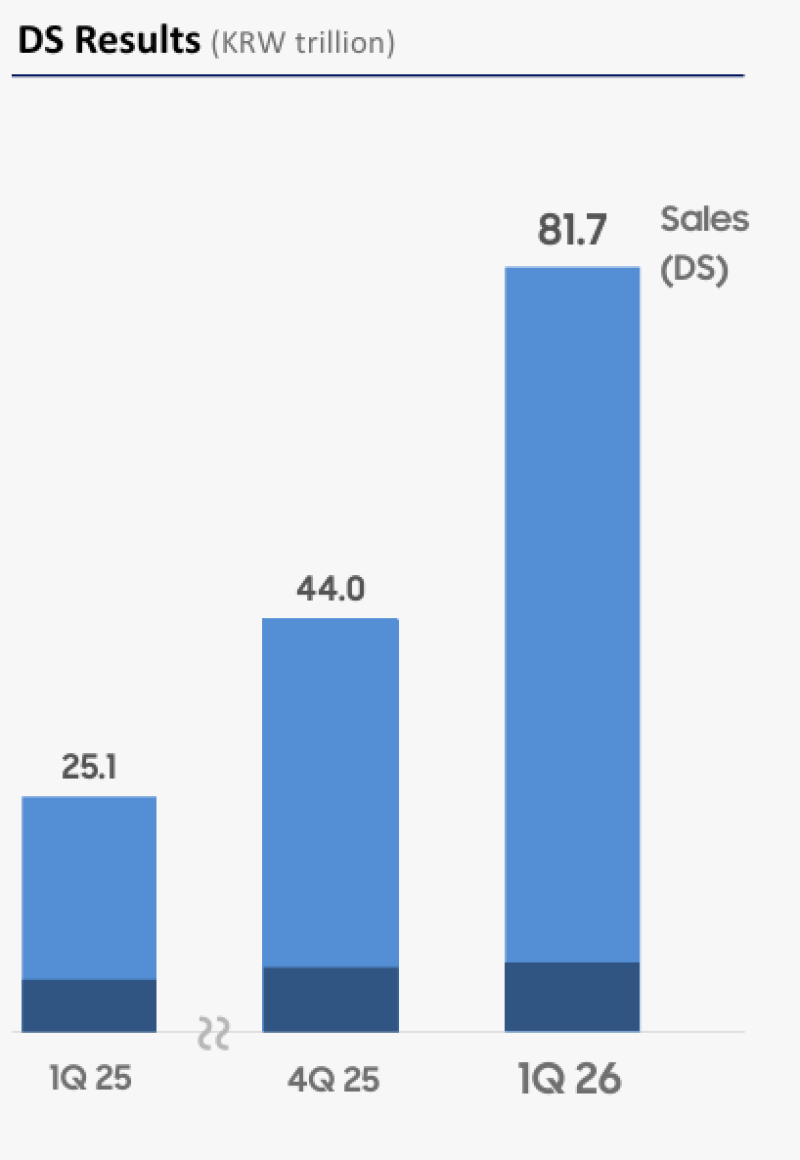
Samsung Electronics. Revenue in the Device Solutions division, which includes memory and semiconductor operations, increased from KRW 25.1 trillion in Q1 2025 to KRW 81.7 trillion in Q1 2026, more than tripling in a year.
The surge helps explain why profit-sharing has become a strategic issue rather than a routine compensation discussion. Revenue in Samsung's Device Solutions business rose from KRW 25.1 trillion in Q1 2025 to KRW 81.7 trillion a year later, reflecting the industry's rush to secure advanced memory for AI infrastructure.
What changed in just one year?
- DS revenue increased from KRW 25.1T to KRW 81.7T
- AI memory demand continued to outpace supply
- Hyperscalers accelerated infrastructure spending
- HBM became one of the most constrained components in modern AI systems
That growth points to a broader shift in semiconductor economics. For decades, memory was regarded as one of technology's most cyclical businesses. Periods of shortage generated windfall profits, only to be followed by oversupply and collapsing margins. AI has altered that equation. High-bandwidth memory is no longer a commodity component. It has become one of the most important bottlenecks in the AI supply chain.
Every modern AI accelerator requires large amounts of advanced memory. As clusters scale from thousands of GPUs to hundreds of thousands, memory demand grows alongside compute demand. Suppliers that once competed primarily on volume are now positioned at the center of one of the industry's fastest-growing markets.
By the Numbers
- Bonus pool: KRW 40T ($26.6B)
- Average employee payout: $340,000–400,000
- Expected 2026 profit: ~$218B
- DS revenue (Q1 2026): KRW 81.7T
- Profit-sharing period: 10 years
Following the Money Through the AI Stack
Samsung's expectations reflect that reality. The company reportedly forecasts profits approaching $218 billion in 2026, nearly seven times higher than the prior period. Whether the final figure reaches that level or not, the direction is clear: AI spending is flowing well beyond chip designers and cloud providers.
The labor agreement offers a glimpse into how that wealth is being distributed. Historically, semiconductor employees benefited indirectly from strong cycles through wage increases and annual bonuses. Today, companies are increasingly tying compensation directly to AI-driven profitability. SK Hynix moved first. Samsung is now following a similar path.
AI infrastructure spending doesn't stop at GPUs. It flows through memory suppliers, fabrication lines, and increasingly into employee compensation.
That may be the most important signal in the announcement. The AI economy is no longer creating winners only at the top of the technology stack. The profits generated by AI infrastructure are becoming large enough to reshape compensation models inside the companies supplying its critical components.
The AI boom is often framed as a competition between model developers, cloud platforms, and GPU manufacturers. Samsung's latest agreement highlights a different reality: some of the most lucrative positions in the ecosystem belong to the companies making the memory that every AI system depends on.
 Victoria Bazir