Saad Ullah

Diesel prices in the United States climbed to $5.38 per gallon as of March 23, up sharply from $5.07 just one week prior and well above the $3.81 level recorded before the Ukraine war began. The move signals renewed inflation pressure and draws renewed attention to commodity markets, with XAU and broader energy assets back in focus.
Diesel at the 75th Percentile: Where Real Prices Stand in 2026
Inflation-adjusted data places current diesel costs in context. Real prices averaged around $4.80 per gallon in March 2026, landing at the 75th percentile of all monthly readings since 2000. That compares starkly to January's average of $3.52, which sat near the 32nd percentile. While today's levels remain below the record peaks of $7.25 in 2008 and $6.51 in 2022, the pace of the current move is what stands out.
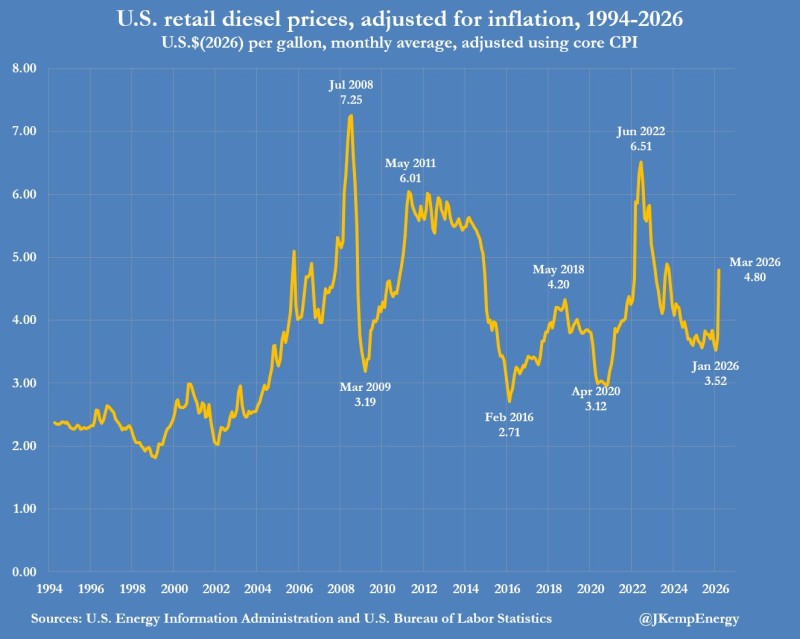
From Fuel to Freight: How Diesel Costs Drive Broader Inflation
The rise in diesel is not an isolated data point. As covered in WTI Diesel Prices Surge as U.S. Pump Costs Jump 40% YoY, fuel has crossed the $5 threshold amid ongoing supply disruptions and geopolitical strain. The spillover into financial markets is equally visible: US10Y Yield Hits 5.23% as the Fed Rate Cut Cycle Reverses reflects how rising energy costs are feeding into inflation expectations and pushing bond markets to reprice risk.
Diesel functions as a cost input across transportation, logistics, and industrial production. When pump prices spike this quickly, the effects ripple into supply chains and ultimately show up in consumer prices. The jump from $3.81 to $5.38 in roughly two years illustrates how persistent energy-driven inflation remains, and why it continues to shape economic momentum across sectors.
 Saad Ullah