Saad Ullah

⬤ China has been quietly loading up on gold for years, but the pace since late 2022 is something else entirely. Official reserves climbed around 260% from October 2022 through early 2026, based on People's Bank of China data. The chart tells a steady story: gradual gains from 2020, then a sharp upward shift after 2022 that shows no signs of slowing. For XAU markets, China's buying isn't background noise - it's one of the loudest signals in the room.
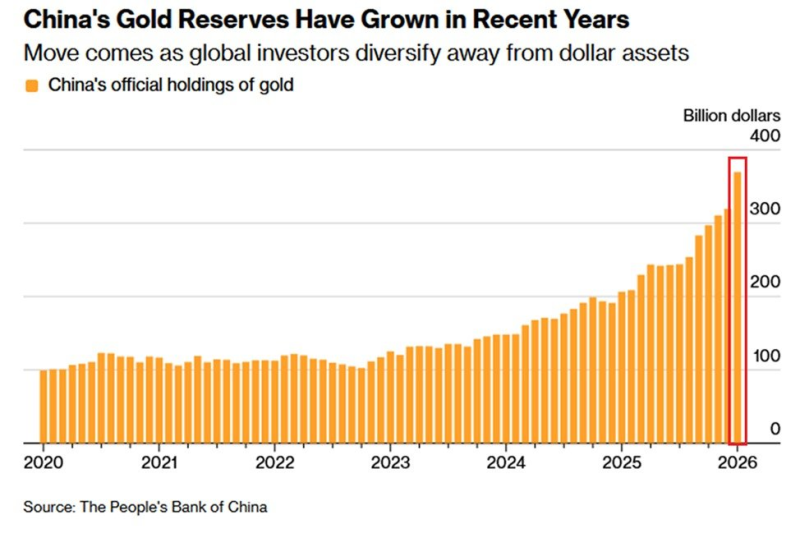
⬤ By Q4 2025, China's gold stash hit a record high, crossing 2,300 tonnes - the most it has ever held on paper. That milestone didn't happen by accident. The People's Bank of China has been deliberately rotating out of dollar-denominated assets and into precious metals, a strategy that contrasts sharply with the more passive reserve management seen in earlier years. As China slashed $683B in Treasuries while gold holdings hit 74 million ounces, the direction of travel became impossible to ignore.
Gold's share of global foreign exchange reserves is expanding - and that expansion is being driven by deliberate policy, not passive market moves.
⬤ China isn't the only one rethinking the rulebook. Central banks globally have been shifting reserve portfolios toward gold and away from Treasuries at a rate not seen in decades. In fact, central banks' gold reserves surpassed U.S. Treasuries for the first time since 1996 - a milestone that reflects just how much the reserve management playbook has changed since the post-2008 era of dollar dominance.
⬤ The bigger picture here is about hedging against a world that feels less predictable. Geopolitical realignments, currency volatility, and persistent inflation concerns have all pushed gold higher up the priority list for reserve managers. Central banks have now pushed gold reserves to their highest level in decades, and with major economies still actively accumulating, global demand dynamics for XAU look structurally supported for the foreseeable future.
 Saad Ullah