Usman Salis

Gold's long-term structure is drawing attention as the current cycle shows a much larger expansion compared to previous moves. The focus is on structure rather than sentiment - with analyst EGRAG CRYPTO pointing out that the market is now entering a phase where the next move may differ meaningfully from the prior trend.
The broader context matters here. Gold has been building momentum across multiple timeframes, and the structural signals now emerging suggest the rally is not simply pausing - it may be changing character altogether.
The Gold Expansion That Mirrors the Past
The chart compares two major cycles: the 2009-2011 move and the current advance. The earlier cycle delivered roughly +82%, while the current one has reached approximately +182%, reflecting a significantly amplified expansion.
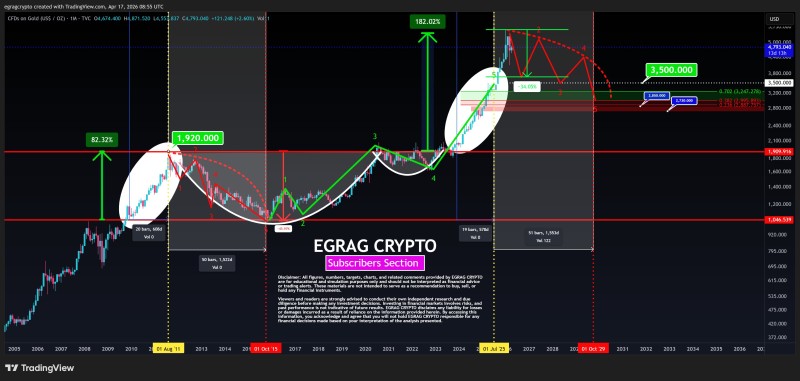
Both cycles follow a similar structural pattern - a strong upward leg followed by a topping phase. The consistency of this structure suggests a repeating sequence, only at greater scale. For context, gold's breakout has already signaled an advancing cycle toward $5,000 and higher, with the current reading adding further weight to that long-term case.
When Gold Expansion Reaches Its Limit
After the latest surge, the chart outlines a transition into a more complex phase. Rather than continuing higher in a straight line, price is projected to move through a series of swings - indicating instability after the peak.
Once a move becomes overstretched, the structure shifts from directional trend to volatility and rebalancing.
This aligns with how extended expansions typically behave. Once a move becomes overstretched, the structure shifts from directional trend to volatility and rebalancing. Recent market analysis also shows gold approaching key structural zones with targets of $7K-$8K after a channel break - zones where consolidation or transition phases tend to emerge before the next move develops.
The Gold Structure That Points to a Shift
The chart emphasizes that the next phase is not about immediate continuation, but about transition. The projected path shows a sequence of lower highs and deeper pullbacks, reflecting a potential change in market behavior.
After a large expansion, markets tend to undergo a reset phase before establishing a new direction.
This is consistent with the idea that after a large expansion, markets tend to undergo a reset phase before establishing a new direction. At the same time, gold's current market performance and 2026 outlook suggests it remains within a larger upward structure, even as short-term dynamics shift.
A Market Moving Beyond the 182% Expansion
The key takeaway from the structure is not a specific price target, but a shift in phase. Gold has already delivered a powerful move, and the current setup suggests the market is transitioning away from pure expansion.
The comparison between past and current cycles reinforces this idea - the pattern is repeating, but the scale is larger, and the implications are different. In this context, gold is no longer just trending. It is entering a stage where structure becomes the dominant signal, and where volatility replaces steady upside.
 Usman Salis