Marina Lyubimova

Japan is preparing one of the most significant transformations of its power sector since the Fukushima disaster. Prime Minister Sanae Takaichi said the government intends to increase the combined share of nuclear and renewable energy to as much as 70%, compared with roughly 30% today.
The announcement is about more than decarbonization. For Japan, the issue is energy security. The country imports approximately 90% of its energy requirements, making it one of the most import-dependent major economies in the world. That dependence leaves households and businesses exposed to swings in global LNG, coal, and oil prices, as well as geopolitical disruptions affecting energy supply chains.
Insert Graphic: Japan imports about 90% of its energy requirements
A Fundamental Shift in Japan's Energy Mix
The proposed target would significantly alter the structure of Japan's electricity generation.
In fiscal 2023–24, thermal power plants fueled by coal, LNG, and oil accounted for 68.6% of electricity generation. Nuclear power contributed 8.5%, while renewable sources represented the remainder.
Under the government's FY2040–41 outlook, thermal generation would fall to 30–40% of the electricity mix. Nuclear power would increase to approximately 20%, while renewable energy could provide 40–50%, bringing the combined low-carbon share close to the government's 70% objective.
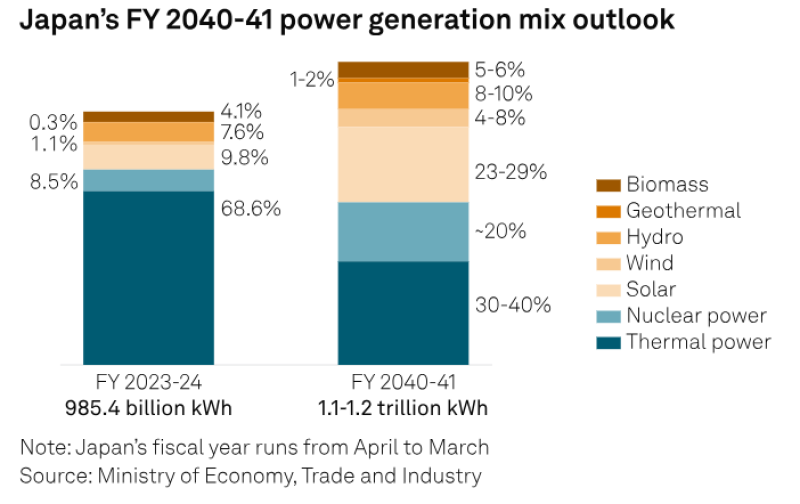
The scale of the transition highlights how aggressively policymakers are seeking to reduce reliance on imported fossil fuels over the next two decades.
Fukushima Still Defines the Challenge
The biggest obstacle to the plan is nuclear power.
Before the Fukushima accident in 2011, nuclear reactors supplied roughly 30% of Japan's electricity, and policymakers expected that share to increase further. Following the disaster, reactor shutdowns caused nuclear generation to collapse and forced utilities to rely heavily on imported fossil fuels.
More than a decade later, the sector remains far below its previous capacity.
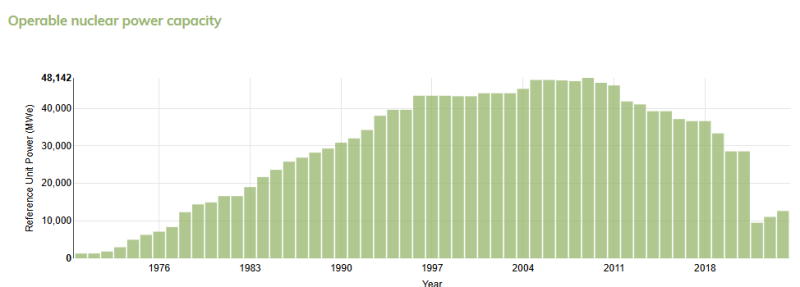
Japan's operable nuclear capacity peaked at nearly 48,000 MW before Fukushima. Although reactor restarts have gradually restored part of that capacity, current levels remain significantly lower than historical highs.
Industry data show that 15 reactors have restarted, while another 10 reactors are undergoing approval procedures. Achieving a nuclear share of around 20% will likely require additional restarts, extended operating licenses, and continued regulatory approvals.
The challenge is not only technical but political. Local governments and communities retain significant influence over reactor restarts, while public opinion remains divided more than a decade after Fukushima. As a result, the success of the government's energy strategy will depend not only on infrastructure investment but also on public acceptance.
Rising Electricity Demand Adds Urgency
Japan's energy transition is also being shaped by rising electricity demand.
Government projections indicate that annual power generation could increase from approximately 985 billion kWh today to between 1.1 trillion and 1.2 trillion kWh by FY2040–41.
Growth in semiconductor manufacturing, data centers, and artificial intelligence infrastructure is expected to place additional pressure on the country's power system. Unlike solar and wind generation, nuclear power provides stable baseload electricity, making it an increasingly attractive option for policymakers seeking reliable supply alongside expanding renewable capacity.
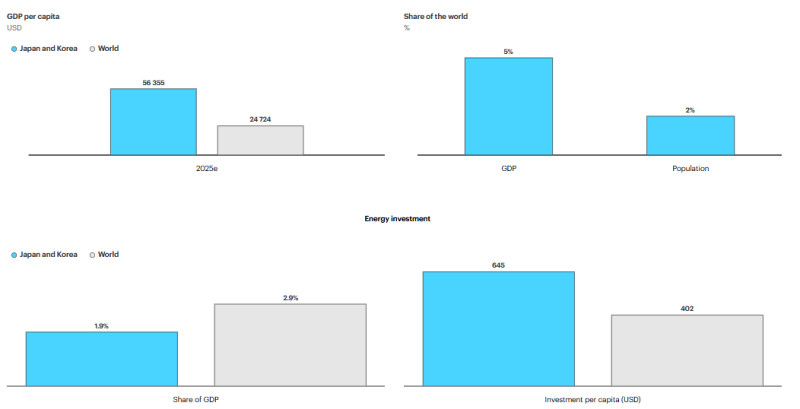
Japan is already among the world's largest investors in energy infrastructure on a per-capita basis, spending approximately $645 per person, compared with a global average of around $402.
Can Japan Realistically Reach 70%?
The government's target is ambitious but not impossible.
The renewable component already accounts for more than one-fifth of electricity generation and continues to expand. The more difficult part will be restoring enough nuclear capacity to lift its share from 8.5% today to around 20% over the next 15 years.
If reactor restarts continue and renewable deployment accelerates, Japan could substantially reduce its dependence on imported fuels. However, delays in approvals, political resistance, or slower-than-expected nuclear expansion could make the 70% target difficult to achieve on schedule.
 Marina Lyubimova