Artem Voloskovets
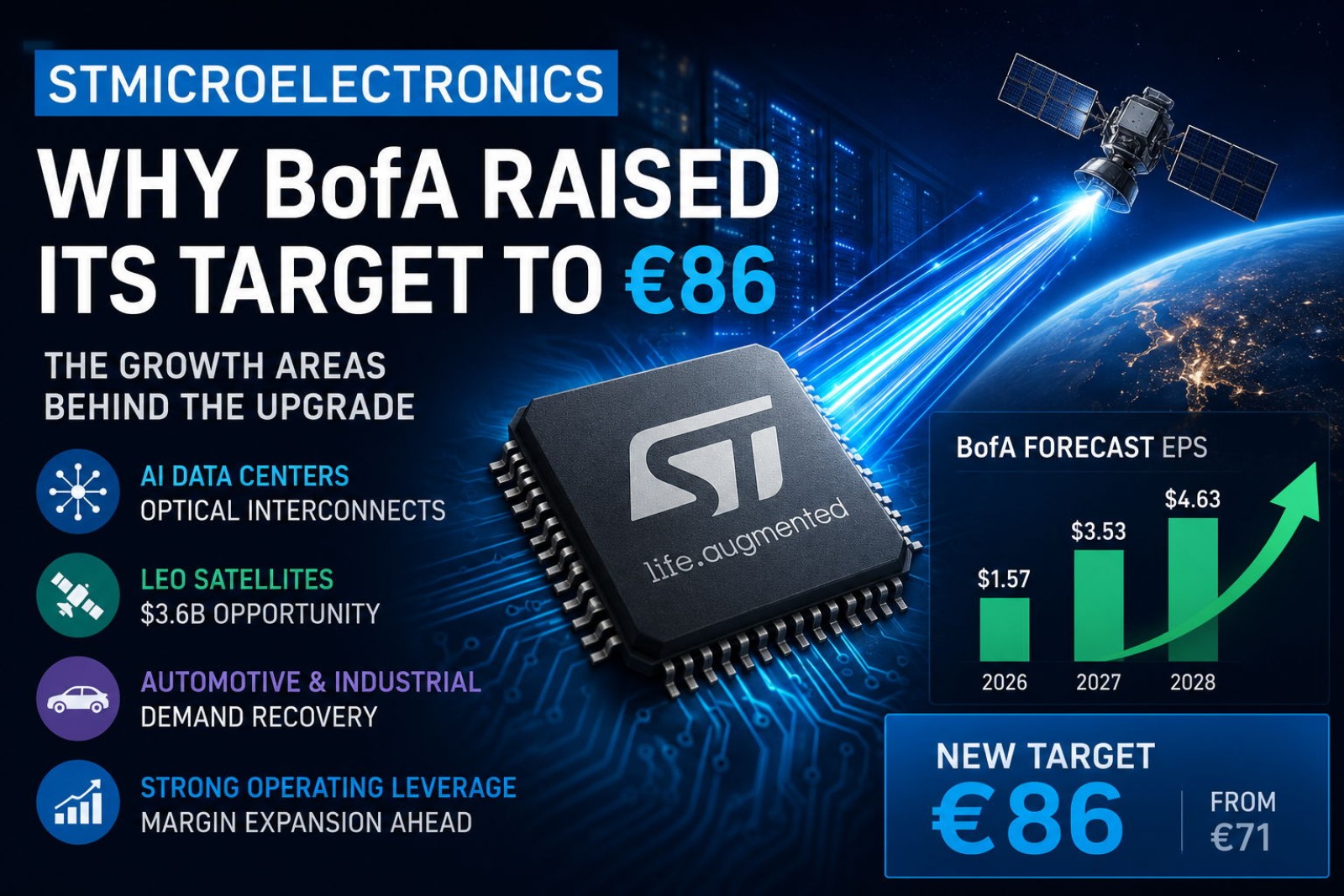
The bank's thesis rests on four factors: optical interconnects for AI data centers, low-Earth-orbit satellites, a recovery in automotive and industrial demand, and higher profitability from improved factory utilization.
1. Optical Interconnects
The largest growth opportunity in BofA's analysis is optical interconnects, which are used to move data between servers and processors inside data centers. BofA expects STM's optical interconnect revenue to increase from $670 million in 2026 to $2.3 billion in 2028.
| Year | Revenue |
| 2026 | $670M |
| 2028 | $2.3B |
The forecast is based on STM's capabilities in silicon photonics, specialty manufacturing processes, and advanced packaging technologies.
2. Silicon Photonics
Silicon photonics is becoming increasingly important as AI systems require faster communication between chips and servers. BofA shows, STM's market share in silicon photonics could expand from roughly 5% today to more than 30% by 2028. A key element of that forecast is Amazon Web Services, which the bank identifies as an anchor customer. Additional customer diversification is expected over time. For STM, this creates exposure to AI infrastructure spending without competing directly in the market for AI accelerators.
3. Low-Earth-Orbit Satellites
BofA also sees satellite communications as a meaningful growth market. The bank estimates STM currently holds roughly 90% market share in its targeted LEO satellite segment and forecasts $3.6 billion in cumulative revenue between 2026 and 2028.
| Metric | Estimate |
| Market Share | ~90% |
| Revenue 2026–2028 | $3.6B |
The forecast is based on increasing launch activity, a broader customer base, and higher semiconductor content per satellite.
4. Automotive and Industrial Recovery
Automotive and industrial customers remain STM's largest end markets. Both segments have been affected by inventory corrections and weaker demand over the past two years. BofA expects conditions to improve gradually, providing support for revenue growth while newer businesses scale. This recovery is an important part of the bank's earnings assumptions.
5. Factory Utilization and Margins
BofA believes STM's profitability could improve significantly as factory utilization increases. The company currently has spare manufacturing capacity. As demand recovers, fixed costs can be spread across larger production volumes, improving margins. The bank expects gross margin to rise from 37.3% in 2026 to 46% in 2028.
| Year | Gross Margin |
| 2026 | 37.3% |
| 2028 | 46.0% |
Part of the improvement is expected to come from lower unused-capacity costs and a larger contribution from higher-margin businesses.
6. Earnings Expectations
The margin outlook feeds directly into BofA's earnings forecasts.
The bank projects:
| Year | EPS |
| 2026 | $1.57 |
| 2027 | $3.53 |
| 2028 | $4.63 |
These forecasts are between 30% and 43% above consensus estimates, reflecting BofA's view that STM's future earnings are not fully reflected in current expectations.
Recent Results
For the first quarter of 2026, STMicroelectronics reported:
- Revenue: $3.10 billion
- Gross margin: 33.8%
- Operating income: $70 million
- Net income: $37 million
The gap between current profitability and BofA's 2028 forecasts illustrates how much of the bank's thesis depends on growth in optical interconnects, satellites, and improved manufacturing efficiency.
 Artem Voloskovets